Abstract
In Islamic finance, mudaraba is a trust financing contract. Mudaraba may be conducted between investment account holders as fund providers and the Islamic bank as a mudarib. It may also be conducted between the Islamic bank, as fund provider, on behalf of itself or on behalf of investment account holders, and business owners and other craftsmen or traders etc.
Mudaraba is a partnership where capital is provided, in cash or assets (no debt is accepted) by one party - the fund provider - and labour is provided by the other party - mudarib.
Both parties can appoint agents on their behalf. A mudaraba contract could be terminated unilaterally except when a term has been agreed by both parties, in which case the mudaraba could only be prematurely terminated by mutual agreement. In addition, if the mudarib has already started the business, in the mudaraba contract, it becomes binding until actual or constructive liquidation.
Keywords
MudarabaIslamic ContractSleeping partnershipDistribution of ProfitIslamic financing
Introduction:
The Islamic financial system has emerged as a very promising and popular system of financing for the last few years (Khan and Bhatti, 2017). Due to its unique feature of providing services on the basis of profit or loss sharing, its popularity has further increased. It has become able to secure a strong place in the financial sector, in competition with conventional banking (Iqubal, 2002; 2007). Although the products and services of Islamic banks, like conventional banks, meet most needs of customers, they are provided under a different framework of banking. The features and requirements of different Islamic banking products and services differ greatly from that of the conventional banking system. Financing by conventional banks is fully based on fixed rate of interest on the money borrowed, but Islamic financing totally prohibits interest as the basis of the contract (Iqubal, 2002; 2007).
Objectives of the Article
The main objective of this article is to identify the distinctive products and services provided by Islamic banks and compare these to conventional banks. The article explores one of the products of Islamic banks in terms of different features and implications. The article is based on selecting ‘Mudaraba’, a product well known in Islamic banking system. The article aims at analysing various aspects of products and services under Mudaraba category of Social Islami Bank Ltd. (SIBL) of Bangladesh. The researcher evaluates how products offered by SIBL under the Mudaraba category differ from its counterpart in conventional banking.
Comparing the extent of profit and loss assumed by different parties in Islamic banking and conventional banking is also an important focus of this article.
Review of selected literature
The Islamic financial system and conventional banking system are based on a distinct underlying framework. The Islamic banking system operates under the framework of normative economic theory, which tries to establish the ethical conduct of business. The principles of positive economic theory guide the operation of conventional banking (Schoon, 2009). Mudaraba is a popular mode of financing under the Islamic banking system. Iqbal and Llewellyn (2002) propose Mudaraba is a type of Islamic financing where Islamic commercial institutions undertake business projects based on profit and loss sharing. Unlike conventional banks, under Mudaraba financing the capital provider not only shares the profit of a business but also the loss incurred by the entrepreneur (Gafoor, 2001). This distinct feature of Islamic banks provides some rights in the business of banks. According to Rahman (2010) in Mudaraba financing the capital provider can specify the area of business that would be undertaken by the capital borrower. But in the conventional banking system, financial institutions do not restrict borrowers from investing in unethical businesses. Although the functions of Islamic banks are almost similar to conventional banks, the modes of delivering these functions are different. Sharing of the risk of business between both the capital providers and the capital employer is promoted by Mudaraba financing, whereas in conventional banking system the loss of risk only falls to the borrower of the capital (Usmani 2002).
Conventional financing guarantees the capital providers a fixed rate of return or interest against loaned funds, which is calculated independent of the project’s performance. According to Financial Islam (2010), the increase or decrease in profitability of the project under investment, does not cause any change in the return of the capital provider in conventional. The Islamic banking system takes into consideration the risk and uncertainty which are always present in every activity in conducting the business. According to Gafoor (2010), in conventional financing, the capital provider always remains assured about the return, irrespective of the profit or loss of the project. Such inequality is not permitted in Mudaraba financing. The Islamic banking system requires both the borrower and the bank to assume an equitable share of the outcome of a certain project (Iqbal and Llewellyn 2002). In the case of profit sharing in Mudaraba, a predetermined ratio is followed by both the parties and if there is a loss, the capital provider bears the actual monetary loss and the entrepreneur sacrifices his labour in exchange. Conventional banks emphasise the rate of interest and payment of the loan amount within certain periods (Visser 2009) and grant a loan on the basis of the creditworthiness of the loanee. But the prime consideration of banks, under the Islamic banking system, is the quality of the project to be undertaken by the entrepreneur. Unlike conventional financing, Islamic Mudaraba financing protocols judge whether the entrepreneur possesses enough business skill and competency to run the business (Schoon 2009). Conventional banks try to consider or value the ethical and moral issues associated with a project financed by them. Islamic banks cannot go beyond a specified value dimension of Islam (Rahman 2010). They cannot invest the funds of the depositors in the areas that will cause harm to the society or will conflict with the Islamic framework. Usmani (2002) stated that as a result, products including alcoholic beverages, gambling, casino and night clubs are not allowed to be financed by Mudaraba or any other mode of Islamic financing.
Mudaraba is a very common and widely used concept in Islamic banking. According to Iqbal and Llewellyn (2002), it denotes a certain type of partnership which is formed by transfer of money from one party to another for the purpose of investment in some selected areas. The party who transfers the fund is termed as ‘Rab-ul-Maal’ and the party who receives the fund for investment and management of the fund is termed as “Mudarib” in this contract. In Mudaraba, Rab-ul-Maal provides the whole amount of investment while the Mudarib does not provide any monetary investment but only his expertise and business competency. Participation of the Rab-ul-Maal in the management of the fund is not allowed in Mudaraba. It is the right and responsibility of the Mudarib to operate the business.
The Islamic banks do not guarantee any fixed rate of return to the depositors of Mudaraba deposit accounts nor do they give assurance of paying a lump sum amount of money from the investment. The borrowers of the fund under Mudaraba financing also do not need to guarantee the bank a fixed rate of return based on money borrowed (Gafoor, 2001). An agreed rate of profit sharing is determined by both the parties at the beginning of the contract (Schoon, 2009).
It is not permissible in Mudaraba to allocate a certain amount of profit for any party. Any rate of profit based on capital provided is also not allowed in Mudaraba contract. For example, it cannot ask the borrower to guarantee a percentage of the capital provided as its return on investment. It can enter a Mudaraba contract with its customers agreeing on a rate of profit, say 60 percent, earned as the share of profit. The rate of profit sharing can differ according to the situations (Rahman, 2010).
Restricted and unrestricted Mudaraba
There are two types of Mudaraba, restricted and unrestricted. Restricted Mudaraba is a type of contract whereby the capital provider can specify the business or area for an investment of his fund. In such case, the Mudarib has to invest the fund in that specified business or area.
In a case of unrestricted Mudaraba, the Mudarib is independent to invest the fund wherever he wants. Full freedom is given by the Rab-ul-Maal to the Mudarib to apply his judgment and knowledge in making investment choices. But in extraordinary cases where the Mudarib wants to take decisions which are not normally taken in regular business operations, he must have to seek permission from the Rab-ul-Maal (Gafoor, 2001).
In a Mudaraba contract the management of the fund has the sole responsibility and is under the authority of the borrower or the Mudarib. Although the Rab-ul-Maal cannot interfere with the management and activities of Mudarib, it has the right to oversee how the Mudarib is carrying out his activities. In conventional banks, borrowers are sometimes restricted to follow managerial guidelines provide by the banks. Conventional banks in many cases impose certain terms and conditions regarding managerial policies to be adopted by the borrower (Kettell, 2010).
In a Mudaraba contract, the profit is shared by the parties according to the agreed ratio. But the expenses associated with activities of Mudarib are not included in Mudaraba. Such expenses of Mudarib include food, clothing, transportation and medical costs. However, when the Mudarib travels for business purpose and needs to spend a night or more away, in such case the expenses mentioned above are borne by the Mudaraba. Mudaraba shall not bear the cost of travel of the Mudarib where he does not overstay a night. Expenses that are typical of the activities under Mudaraba include employee wages, purchase or sales commission and handling cost are all covered from the Mudaraba capital. Such type of expenses incurred by the Mudarib will be recorded under the cost of the product that is produced or sold by the Mudarib. If the Mudarib is engaged in the business of producing or manufacturing ready-made garments, then the above costs of the Mudarib shall be included in the total cost of garments manufactured (Iqbal and Llewellyn, 2002).
If business under the Mudaraba fund is managed by the Mudarib within his own city, expenses other than the product cost are not covered by the Mudaraba. In such cases, he is entitled to receive only his share of profit. Any employee of the Mudarib cannot claim expenses and will receive salary only.
SIBL is a modern and fast growing Islamic bank in Bangladesh. The bank was established to conduct banking business in accordance with the directives of Allah and his messenger Mohammad. The bank was sponsored by Bangladesh’s country’s well-known Islamic scholars and morally responsible business people. From the very beginning, it has shown its commitment to making significant contribution to the national economy of Bangladesh. By operating Islamic values, the bank has experienced steady growth in terms of profitability and customer base. Maintaining a high standard in serving its customers by use of modern technology and offering of a diverse range of products has helped SIBL to attain its objectives. To satisfy the needs of the customers, managers at SIBL carefully design its products and services (SIBL, 2011).
SIBL’s Mudaraba model includes agreements with two different parties. The first Mudaraba contract includes the bank and the depositors who deposit their money under different Mudaraba accounts.
The second Mudaraba contract includes the bank and the entrepreneur. The bank enters with the depositors a contract of paying 70 percent of their profit to them whereas the second Mudaraba contract states that the bank will receive 80 percent of the profit of the entrepreneur’s business. This two-tier Mudaraba has been shown in the following model:
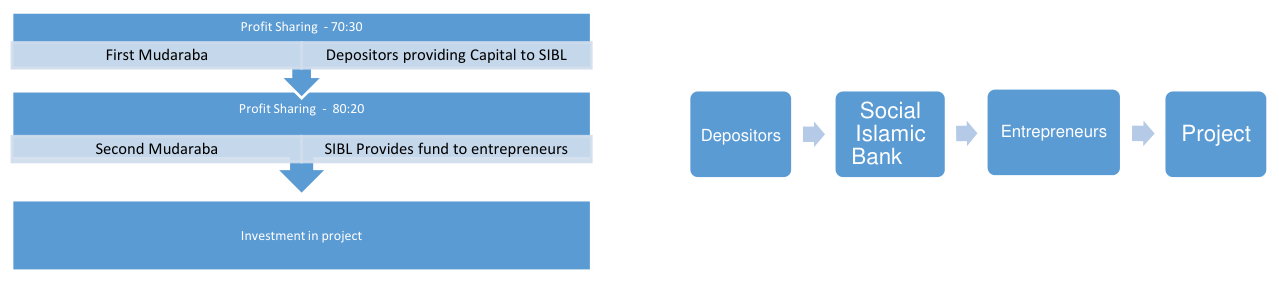
Fig 1: Model of the Mudaraba operation
Evaluation and Comparison with Conventional Banks
The services provided by the Islamic banks are similar to that of the conventional banks. The main point of difference lies in the profit-loss sharing principle of the money invested.
In SIBL, a Mudaraba contract requires the bank to provide the whole investment for the business to be undertaken by the borrower. The entrepreneurs, or Mudaribs, do not provide any monetary investment. Money collected under Mudaraba deposit accounts are pooled together to create a Mudaraba fund. The bank then invests the fund in the businesses that are allowed by the Islamic shariah.
The conventional banks in Bangladesh do not solely invest in the projects undertaken by the entrepreneurs. The borrower himself also invests a part of the project cost from his own pocket. He needs to pay a fixed rate of interest on the fund borrowed from the conventional bank. No Mudaraba fund is created by conventional banking counterparts of SIBL.
Both the liquid and physical assets can be considered as capital by the Islamic banks. Some Muslim scholars are against the system of acknowledging physical assets as capital for the investment of Mudarib (IMF, 2017). Some Scholars support the physical assets for capital and state the assets should be included in the capital and the value of a physical asset must have to be determined exactly. Mudaraba will not be valid unless the assets are properly valued (Schoon 2009).
In conventional banking, Banks do not consider physical asset for the purpose of capital. Although conventional banks finance different assets and products, the main transaction is conducted on the basis of a certain rate of interest on the value of the asset. (IMF, 2017).
Whereas conventional banks enter into contracts with the borrowers on the basis of a fixed rate of interest on their loan amount, Islamic banks and their borrowers decide on a certain rate to share profit from the business. The validity of Mudaraba contract depends on the determination of this definite proportion at the beginning of the contract. There is no specific direction in Islamic shariah law regarding the rate of profit sharing. Shariah prescribes both the parties to determine a rate based on mutual understanding. Both the parties can share the profit equally or in any other proportion. SIBL receives about 60 percent of its profit from Mudaraba business which is agreed by mutual consent. Expenses are first deducted from the profit earned. In Islamic banking if apportioning profit has not been pre-arranged, both the parties will equally share the profit (Gafoor, 2010).
The contractual relationship of Mudaraba can come to an end at any time, by either of the two parties, by serving a notice on the other party. Both the parties, in some cases, can fix a time duration of their contract after the expiration of which the Mudaraba will be terminated. However, this system of imposing time restriction is not supported by all Islamic scholars. Until the Mudarib is informed of the termination of the Mudaraba contract, he will be considered as a part of the Mudaraba contract. During the termination period, if the business has earned profit, such profit will be shared by both the parties according to the agreed rate. If the business has no assets other than cash, this will also be shared by both the parties at the same rate. If the business possesses physical assets, then these should be sold to generate the cash value. The bank will then be given the amount of its capital investment and if any amount left after that that will be shared by both the parties as profit (Visser, 2009).
Conclusion
Islamic banking is becoming increasingly popular in both Islamic and non-Islamic countries (Delwin, 1991). Mudaraba financing offers the borrower the facilities to operate their business with full strength, which is a great opportunity for them (Iqbal and Mirakhor, 2007). Where conventional financing imposes a type of burden of undue interest on the borrower and often put him under a great pressure, Islamic financing provides the borrower full freedom from paying fixed interest to the bank. Islamic banks also do not interfere with the management of the business of the borrower. For financing in a project, Islamic banks do not judge credit-worthiness of the borrower as do conventional banks. Islamic financiers always focus on the quality of the project and its social implications, before they become part of any business (Kettell, 2010). To form a society of equality and care the role of Islamic banking is indispensable.
Products and services of Islamic banks will not only promote social welfare but they will help to create a culture of equal distribution of resources. A legal framework is important to ensure proper functioning of the operations of Islamic financial institutions. The author has tried to establish how the Mudaraba financing works and its effects on business. This article has dealt with investment and financing, and has introduced a mudaraba-based system called ‘participatory financing’ that takes into account present-day realities. This is a new institution specifically developed to address the concerns of Muslims. It has no parallel in the conventional economy, but the individual tools and techniques it uses are ones tested and proved in the conventional setting (Gafoor, 2001; 2010).
References
- Delwin, A. R. (1991). Islamic Banking, Taylor & Francis Ltd, pp. 427 - 456
- Gafoor, A.L.M. (2001). Mudaraba-Based investment & finance, Available: http://users.bart.nl/~abdul/article2.html, Accessed on 12 May 2017
- Gafoor, A.L.M. (2010). Mudaraba-based Investment and Finance. Available: http://www.islamicbanking.nl/article2.html. Accessed 16th July 2017.
- IMF (2017). Islamic Finance: Opportunities, Challenges, and Policy Options, Available: https://www.imf.org/external/pubs/ft/sdn/2015/sdn1505.pdf. Accessed on 12 May 2017
- Institute of Islamic Banking and Insurance (IIBI) (2017), Islamic Financial System, Available: http://www.islamic-banking.com/islamic-finance.aspx. Accessed on 12 May 2017
- Iqbal, M. and Llewellyn, D.T. (2002). Islamic Banking and Finance. Cheltenham: Elgar.
- Iqbal, Z. and Mirakhor, A. (2007). An Introduction to Islamic Finance, Singapore: John Wiley. Available at: http://www.islamic-banking.com/islamic-finance.aspx. Accessed on 15 May 2017.
- Islamic Banker (2017). Types of Mudaraba, Available at: Error! Hyperlink reference not valid.. Accessed on 12 May 2017
- Kettell, B. (2010). Islamic Finance in a Nutshell. West Sussex: Wiley, pp. 01-80.
- Khan, R. and Bhatti, I. (2017). Islamic banking and finance: on its way to globalization. Aim Events. Available at: http://www.aimevents.net/islamicfinance/whitepapers/WhitePaper. Accessed on 12 May 2017
- Rahman, Y.A. (2010). The Art of Islamic Banking and Finance. New Jersey: Wiley
- Schoon, N. (2009). Islamic Banking and Finance. London: Spiramus Press.
- SIBL. (2011). Formal Banking Sector. Available at: http://siblbd.com/html/homepages.php. Accessed 16 July 2017.
- Usmani, M.T. (2002). An Introduction of Islamic Finance. Netherlands: Kluwer Law International.
- Visser, H. (2009). Islamic Finance; Principles and Practice. Cheltenham: Elgar, pp. 81-144.
How to cite
Hasan, M.M. (2017) ‘Mudaraba Financing: a case study highlighting comparisons and differences with conventional financing’, Journal of Contemporary Development & Management Studies, 5(1), pp. 70–74.
Converted from the printed issue (vol05-no1-2017.pdf, PDF pages 69–73). The PDF is the version of record.