Abstract
This paper focusses on the relationship between private life and study of students on a psychodynamic training course with analysis using the twin lens of Freudian theories and Vygotskyian concepts of intermental and intramental planes. Interviewees were randomly selected from four years of study from two Higher Education institutes and questioned about what they found enhanced their learning. A key theme to emerge was how their private lives impacted their learning experience and how personal development enabled by study equally affected private lives. Each year of study evidenced the emergence of several themes, both discouraging and encouraging the student’s ability to study. Findings showed a clear movement of subjects from intermental to intramental thinking as the student journeyed through the four years to the conclusion of the training course.
Keywords
Intermentalintramentalpsychodynamicprivate lifeencouragingdiscouraging
Introduction
In the study (Papé, 2015), data was elicited through student interviews. One criterion for the choice of students for interview was that each pair of students was at a different point in the psychodynamic training course. Data analysis included the extent to which what the student said reflected the stage she had reached on the course. In this chapter I cover, therefore, an overview of the psychodynamic course content, the four years of study on the courses and the features of each year in order to explain the context for these interviews.
The psychodynamic course content and structure, at the two Higher Education institutes at which participants in this were studying, were designed to enable students to construct knowledge in psychotherapeutic skills, psychotherapeutic theory and experience personal development. Students moved through the course in four discrete stages, identified as Years 1 to 4. The content of each stage has a number of particularly distinguishable features. Student interviewees were selected from four key stages, as shown in Table 1 below.
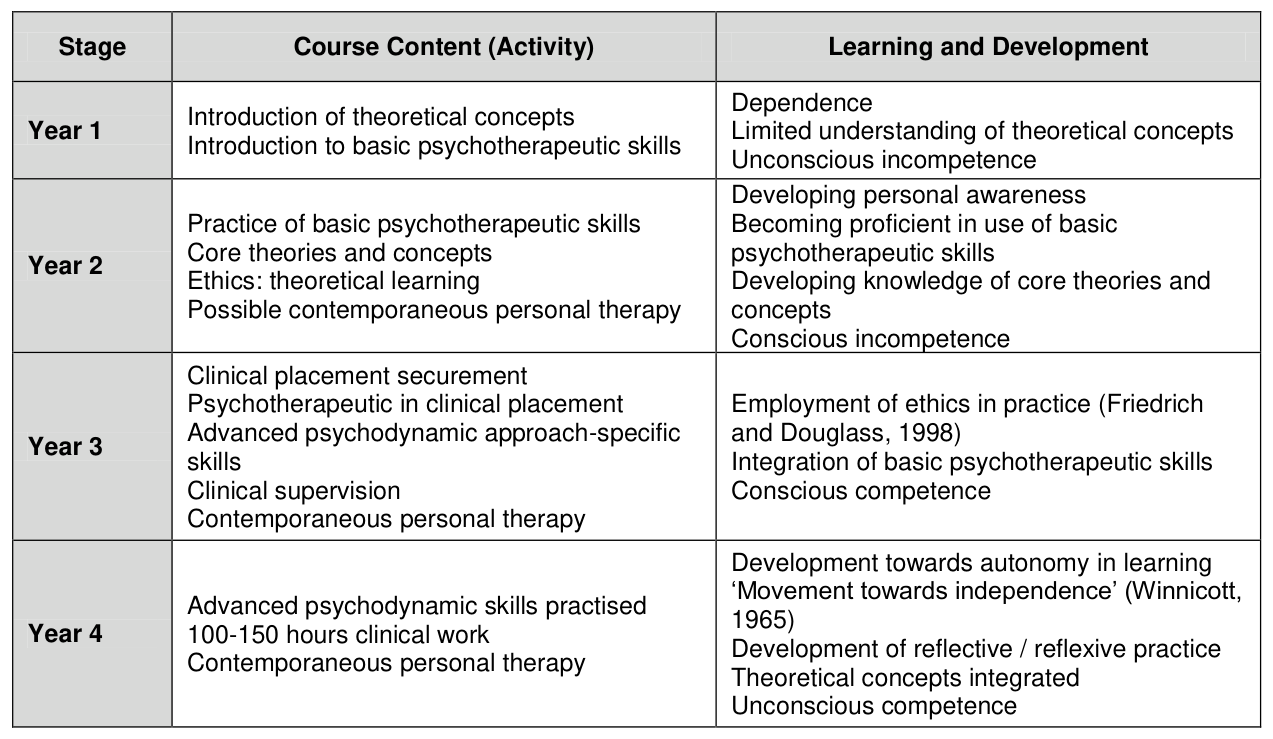
Table 1: Summary of some Key Indicators of Content and Learning/Development of Stage
Table 1 above shows some assumptions about content and the level of activities and learning acquired against four years of study. This table includes some of the key features of the chronological stage reached by student interviewees. I have drawn this material from student self-assessment (Ward et al, 2002) as well as university course handbooks listing stage outcomes. Learning outcomes were similar across all courses. These were accredited by BACP¹⁸ (BACP 2013).
Students from Year 1 started from a position of appreciating support from private relationships, as well as how such relationships influenced their construction of learning. In Year 2, students reported they learned to share with peer students what they considered to be appropriate elements of current private lives as well as some past experiences and relationships. There is evidence in interview texts that students realised personal development had the potential to have some effect on familial relationships as personal changes, facilitated by course experiences, introduced new dynamics into private relationships. The process of personal development had begun, no longer were students as reliant on their tutor. They reported they were able to be assertive in private significant relationships, understanding the possibility that this might involve an ultimate separation. During Year 3, students stated they faced the seeming contradiction of acknowledging the supportive element of a close private relationship, yet negated its importance. This clearly highlighted the problems encountered in an intimate or familial relationship when only one partner worked on personal development. Year 4 evidenced movement towards integration, students reported being able to re-establish private relationships, from the base of their increased personal development
Researcher positioning
The author of the original research on which this article is based (Papé, 2015) is a psychodynamically trained tutor, although no students interviewed had direct experience of that role. As an experienced tutor, in Vygotskyian terms, I was in the role of the more experienced other (Vygotsky, 1987) with clear understanding that students on the course were active agents in the construction of their own learning.
I am trained in the psychodynamic tradition and am accustomed to listening for process interaction (Levis, 1996; Hare et al, 2010) including what is unsaid, as well as content and using clinical experiences as a practitioner for the benefit of the student learner (Groth & Glevoll, 2007). My experience as an educator and therapist supports me in conducting the research.
Methodology overview
I selected the hermeneutic method as part of the interpretivist approach to this research, including the ontological and epistemological philosophical underpinnings. I also consider the interpretivist research tradition and the rationale for qualitative methodology for analysis of data.
The Interpretivist or Hermeneutic Approach
The ontology of the research is constructivist and associated with this is the epistemology, which is interpretivist. The methodology for this research is based on this epistemological positioning. In research undertaken through a phenomenological perspective, it is useful to understand that hermeneutic philosophy (Gadamer, 2006; Arthur et al, 2012) is reflected in the methodology of the research. I collected data through semi-structured interviews of students at points of their learning across the four-year learning cycle of psychodynamic psychotherapeutic training courses.
Gadamer advanced a philosophical hermeneutics that proposed an interpretation of what he considered to be the apposite process of understanding, which rejected any attempt to found understanding on a method or set of rules, perhaps historically found in the teaching and learning the psychodynamic approach to psychotherapy. This is not ‘…a rejection of the importance of methodological concerns, but rather an insistence on the limited role of method and the priority of understanding as a dialogic, practical, situated activity…’ (Malpas, 2014:2.2).
Rationale for choice of interpretive hermeneutic research method
Understanding the meaning and sense of students’ texts of interview transcripts (Back & Gergen, 1963) is central to this research. Folkes-Skinner et al (2010), in their research of psychotherapy training, proposed the aspect of an ‘insider’s view’ (Willig, 2001), formed from the researcher’s engagement with participants’ accounts. It is this ‘insider view’ of the researcher that roots the findings in hermeneutic phenomenology.
The writings of Gadamer, (2006), from original thinking by the existentialist Heidegger, who, as Stern (1991) commented, offered an hermeneutic philosophy to the interpretivist approach for my research because the intent was ‘…to clarify the conditions that can lead to understanding…’ (Holroyd, 2007:1). In this research I have used the term ‘condition’ to refer to the hermeneutic circle¹⁹ found during interviews, between the student and myself as researcher.
The focus of this research is students’ perceptions of what facilitated their learning, from the point in time on the course they have reached, from their world-view. Hermeneutic phenomenology is appropriate for this research because it concerns the situated human being in her world²⁰.
Interpretation is an advanced psychodynamic skill as well as being critical to the process of understanding in hermeneutic phenomenology. Heidegger (1927) proposed that every encounter between individuals affords the chance of an interpretation, which is influenced by the individual’s background and state of ‘being’. Polkinghorne (1983) suggested the individual’s past experiences have a cumulative effect on individual development and it is this aggregation that can be seen clearly in the process of reflective interviews of participants in this study. Kyale (1996) posited that hermeneutics has an aim of finding intended meanings which Vygotsky (1987) considered was central to constructivist thinking and therefore fundamental to this study.
As noted above, Gadamer (1975) postulated hermeneutics clarifies the conditions in which understanding first takes place, in that
‘…hermeneutics must start from the position that a person seeking to understand something has a bond to the subject matter that comes into language through the traditionary text and has, or acquires, a connection with the tradition from which it speaks…’ (Gadamer, 1975:295).
In this research, what is meant by traditionary texts is the texts of the psychodynamic tradition, both classic and modern, found in the interviewed students’ courses. As further clarification Annells (1996) suggested that a definitive interpretation can never be possible as interpretation is an evolving process. The interpretivist framework of inquiry ‘…supports the ontological perspective of the belief in the existence of not just one reality, but of multiple realities that are constructed and can be altered by the knower…’ (Laverty, 2003:26). Thus, there can be no absolute reality (Denzin & Lincoln, 1994). The interviewed students’ realities are their own and as such one reality is not more accurate than another but reliant on the individual’s interpretation of her own experience. Epistemologically, the hermeneutic framework sees a relationship between the knower and the known. Therefore, hermeneutic research is interpretive and concentrated on experience. It addresses engagement in the process of self-reflection and recognises that the researcher’s biases and assumptions are accepted as being integral to interpretative processes.
Data analysis involves co-construction of the participants’ meanings as they enter the hermeneutic circle of understanding (Gadamer, 1976; Rose, 2005). Both the researcher and participant worked together to bring life to what was being explored, through the use of imagination, the hermeneutic circle and attention to both meaning and sense of the language used. Koch (1995) further elaborated this as ‘…hermeneutics invites participants into an ongoing conversation, but does not provide a set methodology. Understanding occurs through a fusion of horizons, which is a dialectic between the pre-understandings of the research process, the interpretive framework and the sources of information…’ (Koch, 1995: 835).
As a result of this hermeneutic process the combination of ‘self-interpreted’ constructions by myself, as researcher, with each participant produced many different realities. This interpretation arose from transcribed texts which, as Allen (1995) emphasised, are core to hermeneutic understanding. It is the fluid interplay between the text and its context, the participants, the researcher and various stages of reflection that enables the interpretations of both meaning and sense (Vygotsky, 1987). Gadamer himself postulated a continuous redeployment of prior ‘…hermeneutical situatedness in terms of the ‘fore-structures' of understanding…’ (Malpas, 2014: 3.1) allows what is to be interpreted or understood to be grasped in a preliminary fashion. The phrase ‘preliminary fashion’ suggests an unfinishedness which Gadamer termed the ‘anticipation of completeness’. This incompleteness always involves ‘…the revisable presupposition that what is to be understood constitutes something that is understandable, that is, something that is constituted as a coherent, meaningful, whole...’ (Malpas, 2014:3.1).
Central aspects of research interpretation included (as above) ‘…the use of imagination, the hermeneutic circle and attention to language and writing processes…’ (Laverty, 2003: 30). The researcher’s hermeneutic imagination (Smith, 1991) might be understood as reflecting on the way the student interviewee speaks or behaves in the interviews, which might give further appreciation of her world experiences. As the researcher, I was aware of how differently each student used language and I have reflected on both student meaning and sense of language, including their juxtaposition, throughout the study.
Hermeneutics, as implied above, include the entire framework of the interpretive process, encompassing written, verbal and nonverbal communication (Gorden, 1980). This communicative process is essential for the therapist to attend to in the therapeutic dyad and therefore has additional relevance for this research. Rose et al (2005) refer to Gadamer’s hermeneutic circle, which cannot be closed in the sense that understanding gained from previous experience remains available as pre-understanding when the next experience is encountered. It is through reflection that the ‘…previous experience informed the next experience…’ (Rose et al, 2005:451). Thus the reflective interview with student participants was informed by their understandings and experiences contained in the original interview. Rose et al (2005) quoting Gadamer (1976), proposed that ‘…hermeneutical reflection played a fundamental role in psychoanalysis…’ and thus psychodynamic therapy, as here a link was made with how ‘…the unconscious motive did not represent a clear and fully articulable boundary for hermeneutical theory…’ (Rose et al, 2005: 451). Gadamer illustrated his thinking, stating that psychotherapy could be described as the work of ‘…completing an interrupted process of education into a full history, a story that can be articulated in language…’ (Gadamer, 1976:41). Gadamer himself appeared to have been critical of the concept of reflection because he saw it as part of a process of learning emerging, rather than being the process itself.
The concept that understanding is always contextualised in the background of an individual’s prior involvement and therefore personal history, is illuminated by the Gadamerian proposal of ‘historically-effected consciousness’. The nature of the historically effected character of understanding, with an awareness of the hermeneutical situation, brings about a phenomenological concept of ‘horizon’, or a limit to an individual’s ‘historically-determined situatedness’. The limit of this situatedness cannot be described as static or invariable as not only is it subject to the effects of history but also ‘…just as prejudices are themselves brought into question in the process of understanding, so, in the encounter with another, is the horizon of our own understanding susceptible to change…’ (Malpas, 2014:3.2). These thoughts help understand the process of psychotherapy from the students’ perspective, in that negotiations within clients’ relationships of their different horizons are necessary to come to an agreement, which might be termed a ‘fusion of horizons’. This fusion is also present in the researcher-student dyad, when coming to an agreement over any particular issue, in the knowledge that a common framework (horizon) will only be achieved ‘…on integration of what is otherwise unfamiliar, strange or anomalous…’ (Malpas, 2014:3.2). The Gadamerian thought applies, of course, that there can never be completeness of agreement, perhaps explained by his proposal that there can be acceptance of what is both familiar and alien provided neither party remains unaffected. This process of continual historical engagement ‘…is an ongoing one that never achieves any final completion or complete elucidation…as our historical and hermeneutic situation can never be made completely transparent to us...’ (Malpas, 2014:3.2).
For Gadamer (1976), hermeneutics are the process of the researcher and participant co-creating reflections which give a greater understanding of the world view of the participant. Indeed, hermeneutic research stresses the centrality of self-reflexivity of the parties involved, by way of an ongoing reflection about the experience as well as being aware of the environment in immediacy, actively building ideas and thoughts of the experience and questioning how such arose (Hertz, 1997). This interpretive process continues until the purpose of the study has been reached (Hall & Stevens, 1991), which is achieved when the findings can be understood by insiders and outsiders alike and there is coherence of research conclusions. The interpretations in this thesis illuminate the participants’ world and remain faithful to the students’ lived experiences (Beck, 1993). The research process and findings are sufficiently described transparently to achieve credibility (Lincoln & Guba, 1985).
The interpretive hermeneutic research tradition accepts the limitations of enquiry, that is, as a practical approach, it is impossible to discover all experiences as some remain hidden. In the current study, I was aware that student respondents, in choosing what they share or hold back, were arbiters in this process and my interpretations of what was said and unsaid was made in this knowledge.
The link between constructivism (Butt, 2006) and psychotherapy on the one hand to hermeneutic thinking on the other (Holroyd, 2007), can be understood in terms of the circle of language (Gadamer, 1976), that is closed in dialogue but open to reflection and influence. This understanding is central to the reasons I chose this methodology. Enabling material to emerge from the pre-conscious to conscious is an important outcome of psychodynamic therapy and hermeneutical reflection plays a fundamental role in this process. However, for Gadamer (2006), it is ‘tact’ that determines how the individual applies thought and feelings to a particular situation, perhaps reminiscent of Freudian superego unconscious behaviour in which the individual fears parental condemnation. He postulated ‘…human sciences are not just feelings and the unconscious but it at the same time a mode of knowing and a mode of being…’ (Gadamer: 2006:15).
The responses of the student, in some way representing her history and course experiences, became opportunities for reflecting on and making connections with previous learning. The way the individual addressed her experience is a result of her historical prejudices and pattern of ways of organising experiences (Stern, 1991; 1997) and thus came to have certain (unconscious) expectations (Zeddies, 2000). This has resonance with the psychodynamic approach, which placed high value on working in transference, allowing and indeed encouraging the transfer of prejudices and patterns of past coping mechanisms onto the therapist. From a sociocultural constructivist perspective, the student’s narrative required both a personal and social dimension. In this context, the student reflected on the changes to how ‘she is’ and how she ‘wishes to be’ in her interpersonal relationships both with me, as the researcher and to her outside world (Butt, 2006).
Personal Relationships
One of the strong influences that students reported on was often fragmented personal relationships and the pressures these brought to learning activities and their patterns of study. Students commented very clearly on the degree to which support from their family influenced their study. Students also commented, on how learning on the psychotherapeutic course enabled the student to apply new ways of ‘being’ and skills learned to her life outside the college environment.
I have widened the analysis to include students’ social interaction with peer students (Bull & McCalla, 2002), as all interviewees mention this was an enhancing activity in their learning experience. The social interaction was an element of students’ private lives as this generally occurred outside the boundaries of the course.
Students reflected on the influence of their personal development on their private lives as well as the affect private lives had on their studies and training. As above, I have utilised the concepts of interpersonal and intrapersonal planes to analyse the location of their learning that the students report.
One of the points addressed at initial selection interview, for psychodynamic psycho-therapeutic training courses, is to ascertain from and give opportunity to the applicant for reflection on whether her private relationship was strong or resilient enough to withstand the potential challenge of changes brought about by personal development of one partner. My experience suggested that, throughout a psychotherapeutic training course, the opportunity for personal development was substantial, particularly during first two years. Applicants were informed that the psychotherapeutic course did not have an agenda to interfere in students’ private lives but considered this change to one individual to be an issue for the applicant to address. The course selected might be the one preferred for study but the timing of commencement might not be right for the individual and her personal circumstance. Some applicants did opt out at this juncture, preferring the certainty and security of known private relationships.
Arguably the greatest transformational change in modern day society, in the early twenty first century, has been the emergence of modern communication in the form of technological innovation, invention and the Internet. Family life has been changed with this capability of rapid communication. The demarcation of family life contained in residential settings and business or work life contained in the office or similar was no longer as clearly defined (Stokols, 2009). Working from home was becoming normalised practice and there now existed a greater opportunity for the blurring of boundaries for all such activities.
Traditional family life had the potential to become threatened as individual members were more continually accessible to others through modern communication platforms and were coping with higher rates of communication and distraction than they experienced in the past (Gleick, 2000; Guzzetta, 2005; Jackson, 2008). It was clear from students’ comments that changing and often fractured familial relationships (Skynner & Cleese, 1993) occurred in past and present, were both motivations and distractions for study. Student interviewees reported how communications and modern work practices played their part in this changing scenario.
Analysis and Discussion
Key
| Students spoken narratives | |
|---|---|
| Year 1 | Green |
| Year 2 | Blue |
| Year 3 | Red |
| Year 4 | Purple |
Students’ narratives, Year 1
As she started her studies, the first Year 1 student related she was able to reflect on how new learning and course experiences enabled her to construct new and changed relationships in her family life as she was personally changing ‘…definitely heightening my awareness in everyday life all the time…’ as she experienced some transfer of course involvements into her outside life ‘…yes, it feels all-pervasive for me…I can see that I am changing…I am a lot quieter in taking things in with my children, my partner and the rest of my family…’. She appeared aware of her need to differentiate and keep separate her private life from what she shared on the course. The professional distancing modelled by the tutor, as being appropriate in the psychotherapeutic relationship, seemed to reinforce her understanding of psychodynamic orientation boundaries and how to construct the counsellor-client dyad ‘…yes, not bring it [personal life] into the lecture sessions, and yet ‘…I suppose in a converse way, I haven’t disclosed much of myself, which could be to do with the course orientation…’. The first Year 1 student acknowledged it would not be appropriate for her to share herself and life when she was learning about the boundaries of the psychodynamic approach ‘…I think if everybody started that, it’s almost crowding the room when we are just finding our feet and building the foundation…’. She was resolute in her determination not to contaminate her learning psychotherapeutic skills and activities by personal material ‘…I appreciate the group support and the discussions, I did notice I am not bringing that to the classroom…’
At this beginning stage, the second student already understood the importance of personal development (McAdams & Olson, 2010), in her training to be a counsellor, as an element of her training course and she was able to address her own desire for personal development (Menon, 2002). The reason for commencing the course, for this Year 1 student, was defined as personal development tempered by ambivalence about career change ‘…to be honest with you I haven’t gone down that line to think I am going to be a counsellor, I am actually an accountant…I am the kind of person who can talk to you and I could put a blockage to what is going on in my personal life…I can do that…’ Thus, she talked of her ability to separate her own material from that of a client ‘…from that point of view I know that wouldn’t be an issue for me…’ without understanding yet the phenomenon of countertransference, an essential concept in psychodynamic psychotherapeutic training.
The interpersonal relationship was at the very core (Klein, 1971; Bowlby, 1988) of human development and the means by which the internal and external worlds (Egan, 1994) undergo a process of development. Again, this Year 1 student reflected on her need for a sense of belonging ‘…I am not the only one looking at me and thinking ‘she’s the outcast’…there are loads of things like that…’. She wanted to be part of a group and her learning experience to be contained and safe on the course, as it was in her private life ‘…yes, part of the group, yes, fitting into that group…as I do in my family…’.
Advances in the study of neuroscience have built on earlier research (Clark & Clark, 1976) and have produced greater understanding of the development of the human brain in childhood (Bruer, 1996; Cozolino, 2006), underscoring the centrality of the interpersonal relationship for personal development (Schore, 2013).
Within the context of the psychotherapeutic course and university, the social and emotional influences were being dynamically integrated into the students’ self-experience and self-structure through the inter-subjective contact with tutors [cf ZPD] and peers. It therefore seemed integral to students’ understanding of personal development that tutors were aware of the ways in which they [tutors] modelled and demonstrated their own self-structure as part of the co-creative process in which they also acted on, constrained and informed students’ self-integration and meaning-making.
When working collaboratively (Wyn, 1990; Blumenfeld et al, 1994) on the student’s development, the tutor could be aware that emotions and emotional interactions (Uttl et al, 2006) were ‘…slippery and unpredictable…’ (Boler, 1999:3) at the best, especially if showing emotions and feelings have been discouraged in the student’s earlier familial experiences. The highly autonomous first Year 1 student characterised her family life generally as being very supportive and loving. She was able to share her emotions appropriately intimately and the developmental phenomena provided another link between the model of the confiding relationship and everyday life (Towbin, 1978). The second Year 1 student became more explicit as she reflected on her future and the effect the course might have on her private life ‘…even if I do it voluntarily it will change my private life, I am not doing this course purely to be a counsellor at the end of it...I am also doing a lot of it for self-development…’. Reservations existed and decisions were left in abeyance ‘…I am not saying it [psychotherapeutic] is not something I won’t do at the end because obviously I came on this course with that goal…’ Without understanding the concept of the phenomenon of counter-transference and how her feelings engendered from such phenomenon might have informed her interventions, this student had already come to the decision that she would be able to separate her own feelings from those of her client. The familial superego messages that helped form the countertransferential feelings were still to be understood, connections had not yet been made.
The second Year 1 student did not want to expose herself to vulnerability, nor was she able to work with dilemma in a state of unknown. She volunteered from a less secure state, removing the need to take a risk when telling her narrative (Kaufman & Davis, 2009). Conformity was volunteered as being helpful for learning as well as a need for assurance before possible exposure of volunteering occurred ‘…I waited for others’ hands to go up as opposed to being the first one…I have an issue with that, a big issue with that…’. She was aware that personal development was likely to be a focus on the course ‘…my blocks, they are going to come up for me…’ When asked what was disenabling in her private life ‘…I wasn’t comfortable being the first one, or second, or third, to say ‘here’s my thing’…’ There seemed little propensity to take risks on the course, especially during the early stages, preferring the security of belonging to the student group seemingly replicated from family life. She could only share her thoughts about her private life with an increase of confidence ‘…how I overcame that block, that discomfort, was when seven or eight people had spoken about their material…what I was going to say…my item was stupid and that people would think…‘what has she brought that in for?…’. The fear and embarrassment of exposure to ridicule prevented, sought participation. This first Year 1 student was only compensated enough to take the risk of involvement by an increase in confidence as she heard other students’ contributions ‘… I was thinking too much of people judging me and making me into this person…then it ended up with me being that last one because everybody else put their hand up…’ Here I might have addressed how her experiences in her private life were replicated on the course. The possibility existed that her behaviour was symptomatic of the youngest child.
Students’ narratives, Year 2
Perhaps strangely, the second Year 2 student had concerns about her ability to contain herself, particularly when she shared perceived confidentialities from her family life ‘… I am not very good at containing but I also was not particularly self-aware, so a combination brought a stage of panic because I didn’t know what was going on and I couldn’t contain it…’. She has already studied at the Year 1 stage, which experience seemed to prepare her minimally for the challenges of Year 2. However, what resonated with her was some theoretical learning she has taken from the course and applied to her family life. She understood the cross-generational nature of how theory could be applied to inform development ‘…also as a daughter as well, I think about the relationship between me and my parents in that way, in that entanglement dependent sort of way…’ Learning on the course enabled her to facilitate changes in her private life ‘…with my children I do as well…especially coming down to the ‘Strange Situation’…I try to be very tolerant of my children’s reactions to me when I go home…’ She has been able to apply some learning from the course to her private life, in particular the application of theory ‘…what resonate with me…the things that stick with me and the ideas of attachment very much resonated with me…I think about that when I am away from my children and with my children as a mother…’ This Year 2 student found social interaction outside the course helped her learning ‘…I think strengthening the relationships and trust…and I suppose the fact that you should be open and sharing…for me, to put myself out there really and knowing that the fear of rejection maybe…that didn’t happen and maybe you’re receiving positive feedback from people who want to make relationships with you…I suppose it’s affirming in a way…that helped me open up more and lower defences…’ The affirming nature of peer support enabled this student to reflect on the potential of what the course could offer ‘…I think I expected more than I got during the course, or gave…I think by the end of the course I developed the relationships with people that I didn’t think I would at the beginning…’, which included personal development ‘…actually that applied to self-awareness as well through not going back to old patterns of behaviour…’
In general, students attending psychotherapeutic courses were encouraged to reflect on family life as part of their progress towards becoming grounded practitioners. Working with genograms and understanding where and who ‘I am now’, through family histories, is basic to students learning about the psychodynamic concept of transference. Students do attend learning courses ‘…with their families in mind…’ (Youell, 2006:136) and this influenced relationships with both the tutor and students’ peer groups. Equally the tutor had expectations of students, evolved from their experiences of tutoring and these might not be consistent with student expectations.
As she concluded Year 2 the first student was starting the process of separating ‘…since the course I haven’t seen anybody but I am in touch with some on Facebook and so forth but that’s about it really…no face-to-face contact…I met up with one or two once every four months or so and I haven’t seen any of them since the course finished…’ The Year 2 student found social interaction with peers enhanced her learning ‘…for me it strengthened the relationships I have made on the course and its finding whether you do have a relationship with somebody to build on outside of that very ‘hot-house’ environment on the course…’
Research (Birditt et al, 2009) suggested that interpersonal tensions, experienced in family relationships, predicted poor future relationship quality, thus the importance of secure early familial relationships was projected in to the student’s ability to form solid relationships with the tutor, in preparation for the creation and maintenance of cathartic client alliances. Both the Year 2 students reflected on cross-generational aspects of relationship development and how the independent lines of influence (Steele & Steele, 2008) between fathers and student and mothers and student differed. These differing relationships countered the classic idea that all love relationships were based on the prototype of the relationship with the mother.
Here Freudian thinking was further extended by the suggestion that the relationship with the father developed due to his [father’s] interactions and because of the thoughts, feelings and fantasies the father carried with him from his own childhood (Steele & Steele, 2008). This built on the classic psychodynamic understanding that resolution of oedipal complex tensions found in family life were solely central to understanding personal development (Lewes, 1998).
Students’ narratives, Year 3
In Year 3, both students reported that the demands of more advanced study and stage became an issue. The very nature of the course at Year 3 level suggested involvement in many areas of the individual student’s life. The first Year 3 student described the course as all-involving ‘…complete personal immersion in the work and the more you are prepared to dive in and the more you put into it, as she [tutor] puts it to me, the more I will get out of it…’ She developed resistance to participation on the course because of the demands of her family life on her time and energy, seeking some balance in her life but held reservations ‘…I think it is tricky…I have the whole other life, family, kids, a bit of work…you know it is a real juggling act…it’s quite hard to switch between the two, dividing time really between the course and non-course activity…’ She experienced difficulty finding time and motivation to devote to her studies ‘…it is quite difficult when I have to sort the kids out, get their tea and bed, then sit down and write very deep stuff about myself, that is tough…’
There was comment by this Year 3 student on the rapidity of the development of peer relationships ‘…in some ways it still feels very early stages…the bonds that are being created on the course are much deeper and are being [developed] much quicker than many normal social bonds…from that point of view I think that relationships are very important…’ The student reflected on the beneficial nature of common experience ‘…it feels like supportive relationship because everybody is in the same boat really…’ This student did see relationships lasting after she completed the course ‘…I would see that as being desirable and I do see people outside the course…’
Further reflection by this Year 3 student identifies social interaction with the peer student as taking on more significance ‘…it’s becoming more and more vital really to both my continuation on the course and the whole idea of the reassurance and support you can get from ranking yourself against your peers…’ The student reflected on her need for support gained through social interaction ‘…it is much more important to me than it has been…I guess it must have something to do with my need for that in order to get through this experience…’ The second Year 3 student reflected on the possibility of retaining friendships after the course ends ‘…I think there will probably be one or two at this juncture that I would like to keep in touch with after the course ends but this could change…I certainly keep contact with people who were on the first-year course, it is a little bit surprising for me really that that has happened…’ However she still retains some ambivalence ‘…it [social interaction] hasn’t happened yet on this year, I wouldn’t say it was vital from my point of view but having said that I wouldn’t turn down an opportunity to meet…’ Indeed, this Year 3 student rationalised the support gained from social interaction she considered she needed as being dependent on the particular challenges she faced at any one time ‘...it depends on where I am personally and in terms of the course, it varies with how much contact I need with other people outside the course…’
The ability to separate family life from college life was stated as being challenged as the student became more involved with the extra demands of psychotherapeutic clients for the first time. The anxiety of starting a psychotherapeutic relationship with a real client was reflected on by in both Year 3 students.
One of the most important aspects of psychodynamic psychotherapeutic was its focus on emotional aspects and psychological repair between human beings (Rizq, 2011). The student’s wish to be cathartic increased her anxiety levels and became emotionally draining. This experience had the possibility to be replicated and re-stimulated in transference during the first few sessions with the client, to such an extent that the student’s concerns could develop into performance-fear, thus increasing anxiety.
It was against this background that the student’s experience of family life had to be assessed by the tutor as to whether the student was ready to take on the challenges of being offered by the course.
Students’ narratives, Year 4
Both Year 4 student reflected on the similarities between family and course life. They related how the extremes and tensions experienced during Year 3 were replaced by self-dialogue on an intrapersonal or individual level (Vygotsky, 1978). The first Year 4 student reflected on internal processes, acknowledging family life provided the secure base (Bowlby, 1988) from which she faced course challenges and extended herself in her thinking processes by reflecting on the difficulties of proving herself to others, especially when sharing familial experiences ‘…I do worry about letting myself down but I know that was a thing becoming less in the other person’s eyes…’ (Y4A). She talked of proving others wrong and how in psychodynamic terms this has strong connotations with superego and familial messages ‘…I mean looking at that now I am saying about proving them wrong…’ She considered the opposing aspects of being correct ‘…it’s the other way round really, rather than proving them wrong would be ‘I proved you wrong because I really can’t do this…you were wrong all along, it was me that was right’…’ Such justification was brought about as a result of reflection.
She was able to critique her superego familial messages and reflected on both the freedom and limitations these provided for her. The familial messages she has internalised from her childhood seem to be based around freedom and altruism ‘…really whatever you want to do is OK, but there is a little caveat on the end of there, which sort of goes something like…but if is something good that’s even better…that was just coming out of the background…’ Later it was noteworthy that an example of hedonism was also included ‘…yes, yes…have fun and do well…’
The second Year 4 student talked about being able to deal with completing the course and leaving in an unstructured way, without expressing regrets or frustration. She had become grounded as she reached towards the stage of unconscious competence; no longer did she have performance-anxiety but attended to the process and finer points of working with clients. She paid attention to the subtler aspects of psychotherapeutic, that is timing and orchestration found in progress to accomplished counsellor or master-craftsman. She picks up on the tension between the college and ‘outside’ life, especially when in Year 4 when she was working largely autonomously, originating much of the work herself, without seeming tutor input. However, because of the need for assignment resubmission separation was being delayed ‘…I still have one foot in the course and I would rather have them both out…I expected to have them both out and standing on my own two feet but I have still got a foot dragging behind…I am still there…’. The Year 4 student confirmed this as being another early familial message from her past that she retains and internalises ‘…it was, that’s right…‘don’t upset other people’ but then that’s not the right thing to do because you can actually collude with people…’ For the second Year 4 student family life was stated as the motivating force ‘…my family is my base…from there I grow…’, which also stimulates her thinking capacity ‘…it’s my brain, thinking…I love my brain, absolutely adore it…using it, stretching it, the things it will do, what it will find…’
Conclusion
Vygotsky (1930) proposed differentiation between mastery and craftsmanship, quoting Engels ‘…if a peasant is master of his land and the craftsman of his craft…then in no lesser degree the land rules over the peasant and the craft over the craftsman…’ (van der Veer & Valsiner, 1994:177). Attribution could be taken to define the role of student and counsellor as being different, however some thought could be given to the progression of the individual from student to counsellor. Certainly, the rate of this evolutionary progress of the Year 4 student (Y4A) was dependent on a number of factors, including early familial experiences and the ability of the student as a counsellor to provide a secure base (Bowlby, 1988) from which her future clients explored their own worlds. The student’s family life had the capacity both to support her studies and to provide on-going distraction. However, the two students at the end of their training reported they did reflect on reality, returning to their private lives and made the necessary adjustments that personal development and relationships required.
References
- Birditt, K. S., Rott, L. M. and Fingerman, K. L. (2009). ‘If You Can’t Say Something Nice, Don’t Say Anything at All’: Coping with Interpersonal Tensions in the Parent-Child Relationship during Adulthood, Journal of Family Psychology 23(6). pp. 769-778
- Blatt, S.J and Luyten, P. (2009). A structural-development psychodynamic approach to psychopathology: Two polarities of experience across the life span, Journal of Development and Psychopathology, 21, pp 793-811
- Blumenfeld, P. C., Krajcik, J. S., Marx, R. W. and Soloway, E. (1994). Lessons learned: A collaborative model for helping teachers learn project-based instruction, Elementary School Journal 94, pp. 539-551
- Boler, M. (1999). Feeling power: Emotions and education, London: Routledge.
- Bowlby, J. (1988). A Secure Base: Clinical Applications of Attachment, London: Routledge
- Bull, S. and McCalla, G. (2002). Modelling cognitive style in a peer help network, Journal of Instructional Science 30). pp. 497-528,
- Cabaniss, D.L. (2017). Psychodynamic Psychotherapy: A Clinical Manual, 2nd. Edition, Chichester: Wiley
- Davis, J. T. (2002) Countertransference temptation and the use of self-disclosure by psychotherapists in training: A discussion for beginning psychotherapists and their supervisors, Journal of Psychoanalytic Psychology 19(3), pp. 435-454
- Egan, G. (1994). The Skilled Helper: A Systematic Approach to Effective Helping (5th. Edition), Pacific Grove, California: Brooks/Cole
- Folkes-Skinner, J., Elliot, R and Wheeler, S. (2010) '’A baptism of fire': A qualitative investigation of a trainee counsellor's experience at the start of training', Journal of Counselling and Psychotherapy Research 10(2), pp. 83-92
- Jacobs, M. (2012). The Presenting Past: The Core of Psychodynamic Psychotherapy, 4th edition, Maidenhead: OUP.
- Jordan, K. (2013). 'Clinical Training of Graduate Students', The Clinical Supervisor, 21: 1, pp. 29-38.
- Kaufman, J. C. and Davis, C. D. (2009). Linguistic Predictors of Creativity, American Psychological Association 2009 Convention Presentation
- Klein, M. (1971). ‘On identification’, in New Directions in Psychoanalysis, M. Klein, P. Heimann and R. Money-Kyrle (eds.), London: Tavistock, pp. 309-345
- Luyten, P. (2016). An attachment and mentalisation based approach to the conceptualisation and treatment of persistent somatic complaints, DIT training, London
- Menon, M. E. (2002). ‘The mission of universities and the vocational paradigm: an investigation of students' perceptions’, Journal of Vocational Education and Training 54(4), pp. 515-532
- Papé. N. R. (2015). Perceptions of What Facilitates Learning on Psychodynamic Therapy Courses: Eight Students' Views, University of Bedfordshire, unpublished PhD thesis
- Skynner, R. and Cleese, J. (1993). Families and How to Survive Them, London: Methuen
- Steele, H. and Steele, M. (2008). Mentalization: Theoretical Considerations, Research Findings and Clinical Implications, An Object Relations Treatment of Borderline Patients with Reflective Functioning as the Mechanism of Change, F.N. Busch, (editor), London: Routledge.
- Towbin, A. P. (1978). The Confiding Relationship: A New Paradigm, Psychotherapy: Theory, Research and Practice 15(4), pp. 333-343
- Uttl, B. Ohta, N. and Siegenthaler A. L. (eds.). (2006). Memory and emotion, Oxford, UK: Blackwell Publishing
- Vygotsky, L. S. (1978). Mind in Society: Development of Higher Psychological Processes, Cambridge, MA: Harvard University Press.
- Vygotsky, L. S. (1987). The genesis of higher mental functions, cited in R. Reiber (Ed.), The history of the development of higher mental functions 4, pp. 97-120, New York: Plenum
- Vygotsky, L. S. and Luria, A. (1994). Tool and symbol in childhood development, cited in J. Valsiner and R. van der Veer (eds.). The Vygotsky Reader, Oxford UK: Basil Blackwell, pp. 99-176
- Wyn, J. (1990). Working class girls and educational outcomes: is self-esteem an issue? Cited in J. Kenway and S. Willis (eds.), Hearts and Minds: Self-esteem and the Schooling of Girls, pp. 119-129, London: Falmer Press, cited in James, P. and Coleman, J. (1998), But will the teacher like it: cultures of competency-based training and the development of proficiency, Journal of Vocational Education and Training 50(3), pp. 403-424
- Yerushalmi, H. (2017). Influences on patients’ developing mentalization, Journal of International Forum of Psychoanalysis, 26, pp. 282-307
Notes
18. British Association of Counselling and Psychotherapy (BACP)
19. See pages below for discussion on Gadamer’s hermeneutic circle
20. Heidegger’s focus was on ‘Dasein’, which is translated ‘the situated meaning of a human in the world’ (Laverty, 2006)
How to cite
Papé, N. (2017) ‘Students’ understanding of how their private lives can encourage or enhance learning experiences; a case study from psychodynamic training.’, Journal of Contemporary Development & Management Studies, 5(2), pp. 105–115.
Converted from the printed issue (vol05-no2-2017.pdf, PDF pages 29–39). The PDF is the version of record.