Abstract
This paper presents a systematic review of the existing literature surrounding student retention. From this foundation retention is discussed within the context of an alternative provider, and how they are responding to the challenge. Finally, this paper discusses how this response can be evaluated.
Introduction
Student retention is an issue across higher education, especially as efforts to widen participation intensify (Gale & Parker, 2017). Alternative Providers (APs) are often at the coalface of widening participation efforts; working with first and second generation migrants and based in their communities. Lacking the equivalent funding of mainstream Higher Education Institutions (HEIs), APs must instead develop highly effective but efficient strategies to increase retention.
This paper begins by discussing the AP context, i.e. the nature of the problem facing APs. This is followed by a systematic review of existing literature surrounding student retention, focusing especially on Community Colleges in the United States which are arguably very similar in nature. The paper discusses what the AP is doing to improve student retention in light of the existing research and their own practice. Finally, the paper discusses how these efforts to improve student retention will be evaluated.
The Alternative Provider Context
The average dropout rate at UK Universities was 6.2% in the academic year 2014/15, down from 7.2% in 2009/10 (Hammonds, 2017). However, it is recognised that most APs have considerably higher dropout rates (Morgan, 2014). Indeed, on some individual courses/programmes this can be as high as 80%. As can be seen in the graphs below, APs dominate the worst-performers in terms of dropout rates amongst HE providers.
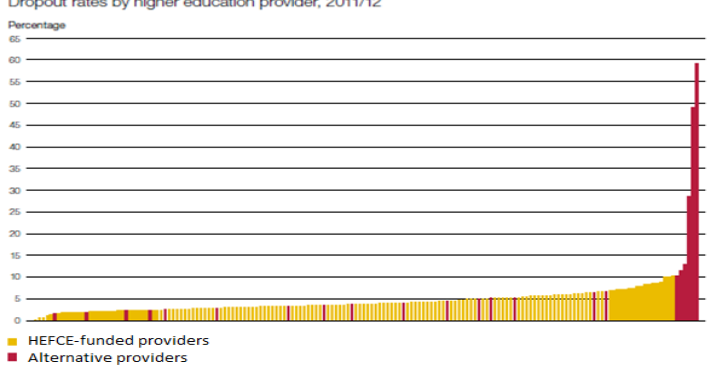
Source: National Audit Office, 2014. Note: National Audit Analysis of Student Loans Company Data. The graph excludes institutions with fewer than 100 students
The following year showed a dramatic improvement in retention figures across the board.
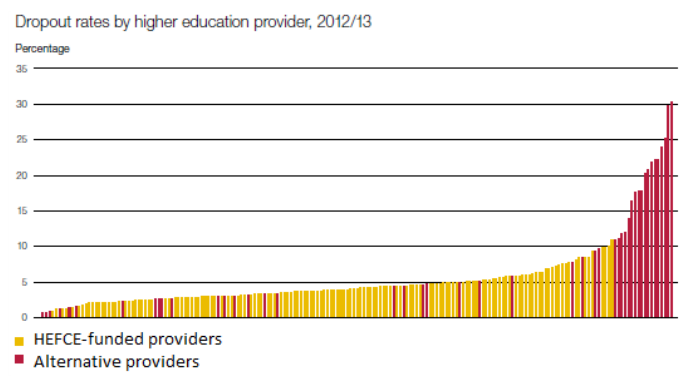
Source: National Audit Office, 2014. Note: National Audit Analysis of Student Loans Company Data. The graph excludes institutions with fewer than 100 students
This issue presents strategic challenges to APs. The first being the reputational damage of high dropout rates, especially the belief that APs offer a poor-quality education and student experience (ignoring APs focus on widening participation). This potentially undermines APs seeking to achieve strategic goals such as Taught Degree Awarding Powers (TDAP).
The second being the loss of income, year-on-year, as students do not progress to the remaining years of their course. This creates the vicious circle of limited resources to invest in additional student support, or teaching and learning (T&L) enhancement.
Systematic review
The research surrounding student retention is both robust and well-developed. A number of themes have emerged, and these are discussed here in a chronological order which reflects the student journey, through recruitment to studying and course completion.
At the beginning of the student journey issues can emerge with student recruitment. Changes to the way HEIs are funded, and incentives given to those which ‘widen participation has meant many institutions have had to place quantity above quality with regards student recruitment. This has implications for student retention. While focusing on science and engineering students specifically Tomkinson, Warner & Renfrew argue that universities must still recruit students “of the appropriate calibre, motivation and experience” (2002: 210) if they want them to reach the end of their courses.
Once students arrive on campus, the reality of HE quickly becomes apparent. Although extensive research on the need to manage the transition from Further Education to Higher Education exists, it has also been found that many students find the reality of HE does not match expectations (Campbell & Mislevy, 2013; Pleitz et al, 2015). Campbell & Mislevy specifically identify the ‘massification’ of HE as a key driver, as students who may previously have followed other routes are encouraged to continue their education into HE. With creating and managing expectations there are clear threats for these new University students used to the spoon-feeding and strategic learning-to-the-test of secondary and FE education in the UK.
As a way of overcoming these initial problems of students ‘settling in’, Frost (1999) and Maldonado, Rhoads, & Buenavista (2005) suggest institutions promoting a sense of community (amongst students, and staff), even with students from non-traditional backgrounds, will have higher levels of student retention.
Kuh & Schneider,( 2008. cited in Provencher & Kassel, 2017; Tinto, 2006; Sieveking & Perfetto, 2001) support the view that resources have to be invested in what Kuh & Schneider call ‘High-impact practices’ (HIPs). These include first-year seminars and experiences, common intellectual experiences, learning communities, intensive writing courses, collaborative assignments and projects, undergraduate research experiences, diverse/global learning experiences, internships, service or community-based learning experiences, and capstone courses and projects. These were found to boost student motivation, and socialist them into academic norms. This is especially important considering the research by Gale & Parker (2017), who found that students with a lack of cultural capital (A person's education [knowledge and intellectual skills] that provides advantage in achieving a higher social-status in society) will struggle in the more middle/upper class environment of higher education.
Student’s general ability to overcome barriers, what may be called resilience was also important given the challenges which emerge through a student’s course of study (Padilla, 1999). Strongly linked to this is student’s level and type of motivation (Slanger et al., 2015; Friedman & Mandel, 2011; Hill, 2013; Polinsky, 2003; Williford et al, 2001). Hill (2013), for example, found that in students which are considered more applied, such as business, attracted students who were more instrumentally motivated. This is in strong contrast to students in more theoretical subject areas such as philosophy and English literature who were more deeply motivated by love of subject.
A range of institutional factors have also been identified as important. Rather than socialising students into the culture of academia, an alternative strategy can be adapting the culture of the organisation to fit that of increasingly diverse students (Zepke & Leach, 2005; Glogowska, et al. 2007). Linked to this is having a diverse executive team (Fincher, et al., 2010). This helps the executive team to deliver services with greater empathy to students with similar backgrounds to their own. This is support by Southwell et al (2016), and Craig & Ward (2008), who both highlight the importance of investing in student support services. This is also linked to the research of Lillis (2011) who found that student retention was strongly associated with the number of student-faculty interactions, and the emotional intelligence of faculty.
It could be argued that a common theme in all of this research is the need to place the student at the centre of institutional and professional practice.
Steps taken to improve student retention
In response to this literature, and the alternative provider who are the subject of this paper took a range of steps to improve levels of student retention.
These included:
- Increasing entry requirements to courses and ensuring that recruitment is driven by academic standards;
- Working more closely with partner institutions to improve assessment notification and general communication;
- Additional 1:1 and small group support;
- Closer monitoring of the personal tutor system to ensure its effectiveness.
- Allowing students to switch personal tutor;
- Administrative staff to follow-up students immediately after any absence and record the reasons so that additional academic or pastoral support can be offered;
- Student representative attendance to be encouraged so that feedback can be acted upon;
- Formation of a student “Council” made up of student representatives;
- Redistribution and reinforcement of the current attendance policy with all teaching staff and students
- “Student Charter” outlining the rights and responsibilities of students;
- Jobs fair and other social events which encourage participation;
- Continued investment in library resources;
- Students supported to organise their events;
- Supporting student to write their own student newsletter;
- Study skills and academic writing workshops on induction and throughout courses;
- ICT skills training for students so they are better able to engage with Moodle and online learning resources;
- Class sizes/groups to be reviewed;
- Peer review of teaching;
- Coaching and mentoring of teaching staff to improve the quality of teaching;
- Additional staff development workshops;
- External training when required;
- Performance management of teaching staff by Course Coordinators.
Evaluating effectiveness
To evaluate the effectiveness of these actions feedback was sought from students through the various committees with student representation.
Levels of student attendance is monitored closely, to both judge the effectiveness of changes made, and also to proactively support students who may require additional support.
Finally, where students do withdraw from their studies the numbers, timings and reasons given will be monitored. Through the regular evaluation of effectiveness, the AP will be reflecting on their practice and where further improvements can be made.
Conclusion
In conclusion, through a systematic review of current research and by reflecting on their current practice the AP who were the subject of this case study have made taken a range of measures to improve student retention. The effectiveness of these steps is being evaluated through a range of qualitative and quantitative measures.
To date, attendance data suggests these measures have begun to have a positive effect when comparing attendance data to previous intakes. However, this evaluation will need to continue before a more substantial dataset can be generated and longer-term conclusions can be drawn.
References
- Burr, P. L. Burr, R. M. & Novak, L. F. (1999). Student retention is more complicated than merely keeping the students you have today: Toward a “Seamless retention theory”. Journal of College Student Retention. Vol. 1.No. 3. pp. 239-253.
- Campbell, C. M. & Mislevy, J. L. (2013). Student perceptions matter: Early signs of undergraduate student retention/attrition. Journal of College Student Retention. Vol. 14.No. 4.pp.497-493.
- Chaves, C. (2006). Involvement, Development and Retention. Community College Review. Vol. 34.No. 2. pp. 139-152.
- Craig. A. J. & Ward, C. V. L. (2008). Retention of Community College Students: Related Student and Institutional Characteristics. Journal of College Student Retention. Vol. 9.No. 4. pp. 505-517.
- Fike, D. S. &Fike, R. (2008).Predictors of First-Year Student Retention in the Community College. Community College Review. Vol. 36.No. 2. pp. 68-88.
- Fincher, M. Katsinas, S. & Bush, V. B. (2010). Executive Management Team demography and minority student retention: Does Executive Team diversity influence the retention of minority students? Journal of Student Retention. Vol. 11.No. 4. pp. 459-481.
- Friedman, B. A. & Mandel, R. G. (2011). Motivation predictors of college student academic performance and retention. Journal of College Student Retention. Vol. 13.No. 1. pp. 1-15.
- Gale, T. & Parker, S. (2017). Retaining students in Australian higher education: cultural capital, field distinction. European Educational Research Journal. Vol. 16.No. 1. pp. 80-96.
- Glogowska, M. Young, P. &Lockyer, L. (2007). Should I go or should I stay? Active Learning in Higher Education. Vol. 8.No. 1. pp. 63-77.
- Hammonds, W. (2017). Are there ‘huge dropout rates’ at the UK’s universities? London: Universities UK. URL = http://www.universitiesuk.ac.uk/blog/Pages/Are-there-huge-dropout-rates-at-the-UK’s-universities.aspx [29/11/17]
- Hill, P. (2013). In it for the money? Understanding motivation amongst students of business. Developments in Higher Education learning and teaching. London: University of Roehampton. Vol. 3. pp. 39 – 47.
- Jones, W. A. & Braxton, J. M. (2009). Cataloguing and Comparing Institutional Efforts to Increase Student Retention Rates. Journal of College Student Retention. Vol. 11.No. 1. pp. 123-139.
- Lillis, M. P. (2011). Faculty emotional intelligence and student-faculty interactions: implications for student retention. Journal of College Student Retention. Vol. 13.No. 2.pp. 155-178.
- Maldonado, D. E. Z., Rhoads, R. & Buenavista, T. L. (2005). The Student-Initiated Retention Project: Theoretical Contributions and the Role of Self-Empowerment. American Educational Research Journal. Vol. 42.No. 4. pp. 60-638.
- Morgan, J. (2014). National Audit Office report fuels concerns over private colleges. Times Higher Education. URL = https://www.timeshighereducation.com/news/national-audit-office-report-fuels-concerns-over-private-colleges/2017349.article [29/11/17]
- National Audit Office (2014). Investigation into financial support for students at alternative higher education providers. London: National Audit Office.
- O’Gara, L. Karp, M. M. & Hughes, K. L. (2009). Student Success Courses in the Community College. Community College Review. Vol. 36.No. 3. pp. 195 – 218.
- Padilla, R. V. (1999). College Student Retention: Focus on Success. Journal of College Student Retention. Vol. 1.No. 2. pp. 131-145.
- Pleitz, J. D. MacDougall, A. E. Terry, R. A. Buckley, M. R. & Campbell, N. J. (2015). Great Expectations: Examining the Discrepancy Between Expectations and Experiences on College Student Retention. Journal of College Student Retention: Research, Theory & Practice. Vo. 17.No. 1. pp. 88-104.
- Polinsky, T. L. (2003). Understanding student retention through a look at student goal, intentions and behaviour. Journal of College Student Retention. Vol. 4.No. 4. pp. 361-376.
- Provencher, A. & Kassel, R. (2017). Higher-Impact Practice and Sophomore Retention: Examining the Effects of Selection Bias. Journal of College Student Retention: Research, Theory & Practice. Vol. 0.No. 0. pp. 1-21.
- Sieveking, N. &Perfetto, G. (2001).A student-centre individual-level university retention programme where attrition is low. Journal of College Student Retention. Vol. 2.No. 4. pp. 341-353.
- Slanger, W. D. Berg, E. A. Fisk, P. S. & Hanson, M. G. (2015). A Longitudinal Cohort Study of Student Motivational Factors related to Academic Success and Retention Using the College Student Inventory. Journal of College Student Retention. Vol. 17.No. 3. pp. 278-302.
- Southwell, K. H. Whiteman, S. D. Wadsworth, S. M. M. & Barry, A. E. (2016). The Use of University Services and Student Retention: Differential Links for Student Service Members or Veterans and Civilian Students. Journal of College Student Retention. Vol. 10. No. 10. pp. 1-19.
- Tinto, V. (2006). Research and Practice of Student Retention: What next? Journal of College Student Retention. Vol. 1.No. 8. pp. 1-19.
- Tomkinson, B. Warner, R. & Rewnfrew, A. (2002). Developing a strategy for student retention. International Journal of Electrical Engineering Education. Vol. 39.No. 3. pp. 210-218.
- Williford, A. M. Chapman, L. C. & Kahrig, T. (2001). The University Experience Course: A longitudinal study of student performance, retention, and graduation. Journal of College Student Retention. Vol. 2.No. 4. pp. 327-340.
- Xu. Y. J. & Webber, K. L. (2016). College Student Retention on a Racially Diverse Campus: A Theoretically Guided Reality Check. Journal of College Student Retention: Research, Theory and Practice. Vol. 0.No. 0. pp. 1-27.
- Zepke, N. & Leach, L. (2005). Integration and adaption: Approaches to the student retention and achievement puzzle. Active Learning in Higher Education. Vol. 6.No. 1. pp. 46-59.
How to cite
Hill, P. (2017) ‘Student Retention at an Alternative Provider: a case study’, Journal of Contemporary Development & Management Studies, 5(2), pp. 162–165.
Converted from the printed issue (vol05-no2-2017.pdf, PDF pages 86–89). The PDF is the version of record.