Abstract
Higher Education is vitally important to meet the demands of employers in the 21st century. Institutions that deliver higher education are expected to feature a quality framework of generated knowledge that fulfils graduate requirements. One of the major challenges faced by international donors and national governments in developing countries since the 1980s has been to accommodate increased student demand for HE access and, therefore, to develop a better educated workforce. This paper discusses some of the emerging pivotal roles that privately owned institutions in developing countries can undertake to enhance access to higher education. The case of Sri Lanka is used to demonstrate the proposition. In conclusion, the author suggests that privately owned institutions have a positive part to play in charting and enhancing educational frameworks in developing countries.
Keywords
Higher Education AccessEnhancementQualityEconomic GrowthPrivate Sector ContributionEducation in Sri Lanka
Introduction
In recent years global Higher Education (HE) enrolment has risen sharply. In 2009, for example, 153 million students enrolled in universities, representing a 50% increase over the figure recorded in 2000, and the number is projected to projected to rise to 262 million globally in 2025 (Labi, 2009). The highest percentage of growth has taken place in developing countries. According to Bloom et al. (2009), half of student enrolment in HE emanates from developing countries that have experienced government budget cuts but also economic growth as a consequence of development loans received from institutions such as the IMF and the World Bank. More than 150 million students who enrolled in HE in 2010 came from developing countries. In the coming 20 years most students enrolling in HE will come from developing countries (Altbach, 2012). Due to the limited resources available in the public sector, and, in order to meet the demands of HE access, developing countries have had to delegate authority to the private sector to enhance HE access (Lee and Healy 2006; Abeli 2010).
Since the 1990s HE has dramatically changed in South East Asian countries and European countries including the UK, due, primarily, to high demand. Countries such as China, Malaysia, Singapore and Japan have seen increased student enrolments and growth in HE of over 50% (Huang, 2011). Some South East Asian countries have established large HE systems with larger enrolments than those existing in European countries such as Germany, France and the UK (Huang, 2011). Rates of expansion seem to indicate that greater access to HE is taking place in South East Asian countries than is the case in Europe. However, that view has been counterbalanced by the fact that European countries, including the UK, continue to record increased enrolment figures for international students, thereby reducing domestic demands for indigenous HE growth in South East Asian countries such as India, Sri Lanka and Bangladesh. As a consequence, governments in those countries have been slow to acknowledge the positive correlation that can exist between private HE provision and the enhancement of HE access in respect of widening access and accommodating domestic demand (Wilkins, Balakrishnan and Huisman).
The situation in Sri Lanka
Very little research has been carried out that specifically focuses on HE in Sri Lanka other than reports published by the World Bank, the Central Bank of Sri Lanka and the British Council. It is the hybrid nature of a few Sri Lankan private and public universities that the author considers worthy of the study. HE in Sri Lanka is important to economic development, since the country has experienced rapid growth due to the private sector’s contribution to HE provision (World Bank 2015). Yet student numbers are still falling short of the Sri Lankan Government’s HE enrolment targets.
HE in Sri Lanka is expected to play a vital role in the future. The country is no longer predominantly agrarian and is looking to develop other sectors for accelerated economic growth (Central Bank, 2005; 2007; 2009; Horii et al., 2008). The present labour market has not met expectations in terms of HE outcomes and a more highly education workforce. Due to limited space availability, only 17-18% of students take advantage of the opportunity to enrol in state universities according to Z-Score selection criteria. The crucial factor is whether or not the government has a plan to accommodate the 82% of eligible students who are qualified to undertake HE. According to the World Bank Report (2005), failure in university education has directly impacted on the labour market in Sri Lanka.
According to the figure-1 bar chart below and the statement given by Musalowa (2015), Sri Lanka at 4.89 has the highest number of individuals qualified to enter HE of the selected six South East Asian countries for available university places. This means that the Sri Lankan government is struggling to manage the requirement to increase student admissions in the HE higher education sector, as compared to other developing countries in the region.
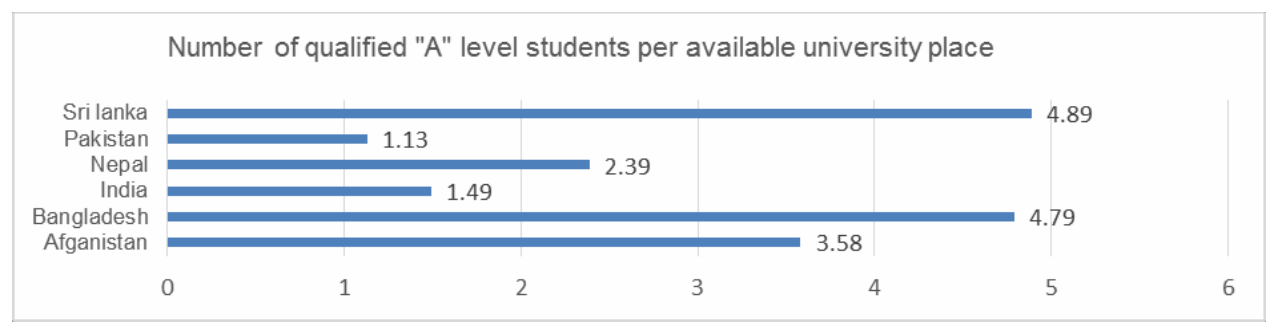
Figure -1 (Source: An Economist Intelligence Unit report produced for the British Council January 2015)
In 2011 Sri Lankan government changed the philosophy of higher education giving access to the private universities to enter into the higher education market under university grant commission (UGC, 2011). The policy has given private providers the opportunity to make a successful contribution to enhance access to HE, while making a successful partnership with foreign universities. Even foreign universities been invited to establish branch campuses in Sri Lanka to accommodate the domestic demand for HE through the policy reform. Despite initiatives introduced to attract private sector activity, the Government has not been able to reach its projected targets.

Current HE availability in the state universities in Sri Lanka. Source: Sri Lanka University Statistics-2016 (UGC, 2017)
Private sector contribution to enhance HE is more significant than before due to the rapid growth of qualified students with no space for HE in state universities in Sri Lanka. Looking at the above table it evident there is little progress being made in increasing state university enrolments. The World Bank reports 2000, 2008, 2009, 2015, & 2016 repeatedly stated the importance of enhancing higher education access in Sri Lanka, if the country has an intention to meet its economic growth targets and meet the demands of the 21st century.
Theoretical context
The term ‘enhancement’ refers to an increase or improvement in quality or value (Middlehurst, 1995; Yorke, 2005; Okoye, et al., 2015). The term enhancement in the context of this paper refers to increasing HE access rates (HE enrolment) in terms of enhancing infrastructure, teaching and learning quality and the provision of resources. The enhancement of access to HE refers to widening participation in HE. HE should be viewed as a ladder rather than as a barrier to students who are seeking to develop their careers. Hence, enhancement is relevant in every aspect to HE and the enhancement of HE itself is vital for any country, as it has a direct impact on economic growth.
Since the introduction of comprehensive education in the 1960s, the UK has sought to provide ‘equality of opportunity’, which is based on a bond between social class and educational achievement within the new school system. The 1988 Education reform legislation introduced by the Conservatives produced a different notion of competition and customer choice in education, and the expectation was that better public services would be delivered to achieve parity and social mobility (Harris and Ranson, 2005). After the New Labour government was established in 1997, a ‘third way’ was developed as an alternative to the perspectives outlined above. The third way was launched as set of policies for social democratic settlement to support each social class. The aim was to tackle poverty and facilitate greater equality of educational opportunity based upon educational attainment (Harris and Ranson, 2005).
Sri Lanka’s education system is largely based on the UK system, as one of the vestiges of colonialism remaining. The challenge now facing the country is how best to focus upon equality in terms of educational opportunities. However, Sri Lanka, like most developing countries, has found that poverty is a barrier to students enrolling in private HE. This is an important distinction to make since much of the literature that has emerged in recent years describes and explores the surge in private HE providers that operate, whether by choice or by constraint, outside the state- regulated system.
Sri Lanka, with its large public HE sector has not seen the same increase in private provision. Consequently, few HE providers have captured the attention of researchers. Whilst private universities in this study have different motivations for providing education than the majority of new providers, more recent private HE literature nevertheless provides a useful background to explore their nature and development. In the broader debate over the privatisation of HE, the focus is typically on the changing nature of public universities. However, this enquiry proceeds from a distinct perspective and considers the extent to which private universities and HE Institutions are able to exploit their ‘Privateness’ within a public-sector framework to enhance HE access in Sri Lanka.
Why the Private Sector
In 2012, Sri Lanka’s Population Census indicated that only 4% of citizens aged 25 years or older contributed to the economy as educated employees with a university degree or other degree level qualification. Limited access to HE continues to reduce prospects for increasing the number of degree holders in the Country. Due to its limited capacity, the state university system with 120,000 students has to reject applicants every year, and qualified students who have passed the international baccalaureate or EdExcel will have no access to these universities (Kelegama, 2017). The important factor to consider is whether or not the Government is providing enough options for those who are eligible, given the lack of places available in the state universities.
Since 2007 increasing numbers of qualified students in HE have presented a challenge to the Sri Lankan Government. The Government has struggled to support increased demand due to a lack of infrastructure and insufficient funds. Student choice and demand has therefore been overlooked. Sri Lanka is just one example of a range of developing countries that have fallen short of educational targets in HE in a similar manner (Aturupane, 2013).
One feature of HE is that it is demand-driven and access to HE therefore depends upon the level of Government interest. The best example of this is the HE system which was implemented in Poland after the collapse of communism in 1989. This enabled HE expansion, inter-sectoral public/private differentiation and meant that more than 50% of qualified students were able to enrol in HE (Kwiek, 2013). Students can now access HE both physically and virtually. Circumstances have changed and the requirements placed on HE have altered dramatically over the time (Gao and Ng, 2017).
To fulfil HE requirements, students need to have direct access to HE when they need it, but Sri Lanka, like most developing countries, still struggles to meet their full potential (British Council, 2015). Access to HE should not be an aspiration that is out of reach for many but regarded as an opportunity for qualified students to build upon secondary education and to achieve career goals in educational attainment. In Sri Lanka, enabling private institutions to enhance access to HE can help to improve Government HE attainment levels in terms of access rates for developing countries (World Bank 2015).
With only 19 state universities and HE institutions to accommodate students in HE, the Sri Lankan government faces pressure as demand is much higher than expected. It has therefore invited private providers to meet the challenge of HE provision under the University Grant Commission (UGC). Thus, the Government is beginning to realise the significance of the private sector’s contribution to HE. However, the revised system as it currently stands has not helped very much to meet the increasing demand. For example, the rate of HE enrolment in Sri Lanka has not significantly changed since 2011, although the Government is being pressured to come up with policies to support better access. The significant transformation that was anticipated has not yet occurred (UGC, 2016).
Quality in Private HE
The quality of HE has become vitally important to meet the demands of employer, and the institutions which deliver HE should focus on the quality framework of generated knowledge of required of a graduate. The main challenge faced by developing countries since the 1980’s has been that national governments and institutional donors have neglected the HE sector (The World Bank, 2016).
Student perceptions and behaviours are important for university educators and these inform the design of programmes, which, in turn, impact significantly upon student enrolment. Student performance varies based on the learning environments in which they study and the quality of teaching and course design (Lizzio, Wilson and Simons, 2002). In recent years, studies have shown that the theories of learning have become central to HE. This is particularly true of individuals entering HE from non-traditional backgrounds who have to adapt to new learning environments to achieve the best outcomes from their programmes (Christie et al, 2008).
According to the Higher Education Funding Council for England (1998), the quality of teaching and learning matters a great deal to the survival of HE institutions and impacts significantly upon the choices that students make. Policies in teaching and learning enhancement must take measurements of quality firmly into account. Meeting quality standards will impact positively upon the image of HE institutions and will influence the learning outcome of graduates.
In respect of private HE Providers, the enhancement of quality in teaching and learning is likely to impact significantly upon student choices, because the word ‘Privateness’ in the UK HE sector system has not been traditionally regarded as compliant with the quality standards required of public universities. It has been isolated without having a proper coordination with the national quality framework to meet the standards expected in HE (Lewis, 2002). Government mistrust of the private HE sector has also characterised Sri Lanka’s past approach to HE development.
The quality enhancement of teaching and learning has a direct impact on increasing academic outcomes for students, and this has an indirect impact on society, the economy and employers and, ultimately, on the wealth of nation (TQEC, 2003). Multiple researchers have identified the correlation between the quality of teaching has and effective learning. Hence changing societal perceptions of the private sector’s contribution towards HE access, and enhancing the quality of teaching and learning has been paramount to achieving success in terms of access to HE (Martin et al.,2000; Dunkin and Precians, 1992; Li, Lee and Kember, 2000; Biggs, 1999). Hence, the Human capital framework in education is important to help to develop the country into a position of economic stability. Enhancing the capacity of HE is more important to meet demand. Failure to meet demand may lead to a “brain drain” in Sri Lanka (WiswaWarnapala, 2010).
Implications for Management
“Widening Access” in HE has been a central agenda in the UK and in many countries around the world (Bowes et al., 2013; Croxford et al., 2014; Evans et al., 2017). Despite various structural, socio-cultural and economic differences between nations, HE enhancement through policy enactment has been similar in most countries (Croxford and Raffe, 2015).
According to the Higher Education Funding Council for England (HEFCE, 2005), “HE is a major contributor to society’s efforts to achieve sustainability – through the skills and knowledge that its graduates learn and put into practice, and through its own strategies and operations”
The contribution of HE has had a significant impact on the development of any country socially and economically. Amongst other things, strategies to encourage growth in the sector, curriculum development, extra-curricular activities, and excellent pedagogy have enabled students to develop new skills as well as values and knowledge, and this has subsequently contributed to the sustainable development of employer demand (Cotton et al, 2009; Ozuem and Lancaster, 2015). Singapore and Dubai have established themselves as successful education hubs and they are seen increasingly as “Role Models” in international HE provision (The World Bank, 2008).
In 2010 Mahinda Chinthana, the former President of Sri Lanka, announced that Sr Lanka would become an education hub for South Asia by 2020. The strategic goal of Mahinda Chinthana was to increase opportunities and access to HE. After five years of Mahinda Rajapakshe’s government, plans have been criticised because new universities and new programmes have not been established within the first five years of the new Government’s regime. Policy formation has not been practical or reliable (Aturupane, 2013).
International partnerships mainly rely on national government financial incentives that support the establishment of foreign universities within the country but not curriculum development. This has implications for student achievement and market-oriented outcomes. For example, the Government of Singapore has offered financial support to foreign universities to attract them in order to develop an education hub.
In Sri Lanka, however, HE reform is a case of political peril and promise. According to the World Bank Report (2009), Sri Lanka’s HE sector faces urgent challenges which include low space availability for HE access, a lack of ICT knowledge and low attainment in the English Language amongst graduates. This has had a major impact on employment demand, especially in terms of private sector employment.
Four components have been funded by the World Bank Project for Sri Lanka- “HE for the Twenty-First Century”, a project worth SD$ 25.6 Million. Component three of the project supports the development of an alternative HE sector. Component four of the project focuses on the development of human resources through monitoring and the evaluation of communication. US$ 5.3M and US $10.8 have been injected into components three and four to develop a Higher Education Institutes’ (HEIs) Foundation to follow the National Qualification Framework (NQF) in both the Public and Private HE Sectors (The World Bank Report, 2016).
The main question is whether or not the US$ 25.6M granted by the World Bank for the development of HE in Sri Lanka has been successful in meeting the Country’s demand for greater access to HE. According to recent reports and popular views it has not met the demand for HE access and has been seen as a poor use of funds.
Conclusion
According to Hannon, Faas and O'Sullivan (2017), social and cultural capability affects the ability of students to be educated, because it allows students to make choices in HE that will impact upon their offer of a place at a university. This will lead to individual freedom of choice in terms of access to HE.
In recent years HE has expanded significantly. Using the capability framework as a useful approach, researchers have argued that HE can impact positively on human development which, in turn, progresses the development of knowledgeable human capital. Sri Lanka and other developing countries can use the capability framework approach to enhance access to HE (Hannon, Faas and O'Sullivan, 2017).
HE offers opportunities for everyone: increasing social mobility and enhancing career opportunities and the social lives of those who are educated. It allows people to distribute knowledge and ideas, to be creative and innovative, to foster scientific literacy and to sustain intellectual properties. Graduates can increase national productivity and the prosperity of the country in which they live, and they can find solutions to global problems. Hence, enhancing HE in any country, will impact directly and positively upon the development of human capital. If traditional public HE provision is failing to meet the demands of students looking to enrol on HE, a compelling idea is to develop private HE provision or to license private HE provision to enhance access to HE (Hoskins, Leonard and Wilde, 2017). Licensing, for example, might present a very effective option to counteract the ease of illegal reproduction. (Marginson (2016).
Traditional public HE is not sufficient to meet the demands of HE in developing countries like Sri Lanka. Even a country like China with its 3000-year old traditional civilisation has supported private HE provision. Governments in developing countries can fill the gap in HE provision by supporting the private sector HE initiatives to improve the quality of human capital to meet the demands of 21st century employers. Enhancing private HE provision will enable Sri Lanka, and other developing countries, to achieve economic growth through knowledgeable human capital that can compete on the world stage (Green, Henseke and Vignoles, 2016).
References
- Anon, (2016). [online] Available at: Worldbank.org, (2015). Sri Lanka Overview. [Online] Available at: http://www.worldbank.org/en/country/srilanka/overview [Accessed 22 Nov. 2015].
- Aturupane, H. (2013). ‘Economic Benefits and Options for Financing Higher Education in Sri Lanka’, Sri Lanka Journal of Advanced Social Studies, 2(1).
- Croxford, L. and Raffe, D. (2014). ‘The iron law of hierarchy? Institutional differentiation in UK Higher Education’, Studies in Higher Education, 40(9), pp.1625-1640.
- Dunkin, M. and Precians, R. (1992). ‘Award-winning university teachers' concepts of teaching’, Higher Education, 24(4), pp.483-502.
- Evans, C., Rees, G., Taylor, C. and Wright, C. (2017). ‘Widening Access to Higher Education: the reproduction of university hierarchies through policy enactment.’ Journal of Education Policy, pp.1-16.
- Gao, F. and Ng, J. (2017). ‘Studying parental involvement and university access and choice: an “interacting multiple capitals” model.’ British Educational Research Journal, 43(6), pp.1206-1224.
- Green, F., Henseke, G. and Vignoles, A. (2016). ‘Private schooling and labour market outcomes.’ British Educational Research Journal, 43(1), pp.7-28.
- Hannon, C., Faas, D. and O'Sullivan, K. (2017). ‘Widening the educational capabilities of socio-economically disadvantaged students through a model of social and cultural capital development’, British Educational Research Journal, 43(6), pp.1225-1245.
- Hoskins, B., Leonard, P. and Wilde, R. (2017). ‘Negotiating uncertain economic times: Youth employment strategies in England’, British Educational Research Journal, 44(1), pp.61-79.
- Huang, F. (2011). ‘Higher education from massification to universal access: a perspective from Japan’, Higher Education, 63(2), pp.257-270.
- Lewis, B. (2002). ‘Widening Participation in Higher Education: The HEFCE Perspective on Policy and Progress.’ Higher Education Quarterly, 56(2), pp.204-219.
- Li, N., Lee, K. and Kember, D. (2000). ‘Towards self‐ direction in study methods: The ways in which new students learn to study part‐time’, Distance Education, 21(1), pp.6-28.
- Lizzio, A., Wilson, K. and Simons, R. (2002). ‘University Students' Perceptions of the Learning Environment and Academic Outcomes: Implications for theory and practice’, Studies in Higher Education, 27(1), pp.27-52.
- Marginson, S. (2016). ‘Public/private in Higher Education: a synthesis of economic and political approaches’, Studies in Higher Education, 43(2), pp.322-337.
- Middlehurst, R. (1995). ‘Quality enhancement in Higher Education’. Engineering Science & Education Journal, 4(6), pp.244-248.
- Okoye, K., Okwelle, P. and Okoye, P. (2015). ‘Enhancement and Innovation in Higher Education in Nigeria through Technical Vocational Education and Training (TVET) and Entrepreneurship Education’, Advances in Social Sciences Research Journal, 2(5).
- Ozuem, W. and Lancaster, G. (2015). ‘Questioning: a path to student learning experience’, Education + Training, 57(5), pp.474-491.
- Warnapala, W. (2010). Aspects of politics and higher education in Sri Lanka. 1st ed. Colombo: Godage International Publishers (Pvt) Ltd.
- Washington, D.C.: World Bank (2009). The evolving regulatory context for private education in emerging economies. Report.
- Washington, D.C.: World Bank, (2016). Implementation completion and results report –Sri Lanka Higher Education for the Twenty-First Century Project.
- Yorke, M. (2005). ‘Formative Assessment in Higher Education: Its Significance for Employability, and Steps Towards Its Enhancement.’ Tertiary Education and Management, 11 (3), pp 219-238.
How to cite
Ariyawansha, P. (2018) ‘Higher Education Enhancement and Privately-owned Institutions in Developing Countries’, Journal of Contemporary Development & Management Studies, 6(1), pp. 18–27.
Converted from the printed issue (vol06-no1-2018.pdf, PDF pages 19–28). The PDF is the version of record.