Abstract
Drawing upon contemporary learning theories and empirical research, this article evaluates the foundational underpinning, role and implementation challenges of Active Learning Framework (ALF) for Widening Access Mature Students (WAMS) at London Churchill College (LCC) in enhancing student engagement, retention, and academic performance. The study provides an evidence-based theoretical foundation for the design of the ALF and offers recommendations for its effective implementation within higher educational pedagogy for adult in general but with particular focus for WAMS citing references to key findings from recent research on adult learning strategies, and personalised pedagogical approaches. This article explores the principles, methodologies, and implications of ALF in the context of higher education. The framework encapsulates and promotes active learning by incorporating interactive learning, real-world applications, and continuous formative assessments to create an active and dynamic academic environment.
Keywords
Active LearningAdult LearningWidening Access Mature StudentsWAMS
Introduction
The ALF at LCC is designed to enhance engagement and retention, foster critical thinking, and bridge the gap between theoretical knowledge and practical application for WAMS. Active learning is particularly suitable for WAMS as the study finds that they prefer to use their experience as a resource and they expect higher education to be relevant to their life and/or career (Uddin, 2022; Uddin 2023). Therefore, any design of an active learning framework for institutions with sizeable WAMS should bear in mind that, unlike traditional students, WAMS enter higher education with diverse backgrounds, prior experiences, and specific expectations regarding their learning journey. They often juggle multiple responsibilities, including employment, caregiving, and financial commitments, which necessitate a learning environment that is flexible, interactive, and directly applicable to their lived experiences (Uddin, 2022; Uddin, 2023).
Despite explicit benefits and relevance of active learning methodologies for WAMS, there is a paucity of research on the development or even availability of active learning frameworks adopted by various adult educators and institutions in their practice setting. Due to absence of research on these often informal frameworks, many adult educators have to “reinvent the wheel” and still pursue “trial and error” to formulate yet another informal framework for their own practice. Many such educators have advocated for a formal framework to be used as a reference point to align their teaching practices.
As part of the teaching and learning strategy, London Churchill College (LCC) has recently designed and introduced the Active Learning Framework (ALF) to foster an inclusive and dynamic educational environment. ALF aligns with contemporary pedagogical strategies, aiming to shift from passive knowledge transmission to student-centred, interactive learning. By incorporating life-centred teaching, collaborative activities, and experiential methodologies, ALF aspires to enhance student engagement, knowledge retention, and professional readiness. Given its particular relevance for WAMS, the framework seeks to provide structured learning experiences that cater to their diverse needs. However, as ALF is in its early stages of adoption, this article offers the foundational underpinning particularly in regard to the active learning for adults, its role in in enhancing student engagement, retention, and academic performance, explores its initial implementation, identifies challenges faced by LCC educators in integrating active learning strategies, and suggests a way forward for its effective implementation in higher education.
Active Learning and its role for Widening Access Mature Students (WAMS)
A broader pedagogical model, the NCL Teaching Practices Framework, was developed by Uddin (2022) for another higher education provider. This framework underscores active learning as a student-centred process in which WAMS collaborate with fellow students and educators, who act as facilitators, and enage through structured, meaningful discussion and activities such as case studies, problem-based learning, and experiential applications (Uddin, 2022). The underpinning concept of the teaching practices framework is in line with Mezirow’s (1991) transformative learning theory, asserting that adult learners engage more deeply when prompted to critically reflect and reassess their assumptions. Through interaction, collaboration and reflection, active learning enables students to connect academic theory with lived experience, making it particularly effective for mature learners.
The NCL Teaching Practices Framework highlights the importance of connecting theoretical knowledge with practical, context-dependent experiences, which is critical for WAMS’ academic achievement and career progression (Uddin, 2022). By encouraging a dynamic and inclusive learning environment, active learning mitigates barriers to participation, thereby facilitating the academic success of WAMS.
The NCL Teaching Practices Framework offers a structured yet adaptable approach to enhancing student success by guiding lecturers in addressing key factors influencing the teaching and learning processes. Combining normative and prescriptive elements, it provides a conceptual foundation alongside practical strategies for effective teaching. The framework emphasises five core elements: collaborative and engaging learning environments, career-focused and skills-based instruction, the application of theoretical models to real-world contexts, reflective and reasoned learning, and the cultivation of mindsets, values, and aspirations (Uddin, 2022; Uddin, 2023). While comprehensive, its broad scope lacks the methodological precision, collaborative tools, pedagogic techniques and practices necessary for the design of the teaching delivery, particularly in fostering active learning.
The design and implementation of an Active Learning Framework (ALF) is essential in addressing the limitations of the NCL Teaching Practices Framework, particularly in providing structured methodologies to enhance student engagement and facilitate learning. While the NCL framework acknowledges collaboration, it lacks specific strategies for implementing interactive and participatory teaching methods. In contrast, the ALF is a structured pedagogical approach that integrates evidence-based techniques to enhance student engagement and knowledge retention. This framework includes strategies such as think-pair-share, flipped classrooms, case-based learning, and problem-solving exercises, each of which has been shown in educational research to promote deeper understanding and critical thinking. However, the effectiveness of these methods varies depending on subject matter, learner preferences, and instructional design. Rather than presenting active and passive learning as a strict dichotomy, ALF acknowledges that well-structured lectures, when combined with reflective activities, can also foster meaningful learning.
Empirical studies have demonstrated that active learning enhances cognitive retention through mechanisms such as retrieval practice, scaffolding, and increased student interaction. Retrieval practice, also known as the testing effect, involves actively recalling information, which strengthens memory retention. Research indicates that effortful retrieval from long-term memory enhances learning outcomes (Yang et al., 2022). Scaffolding, which provides structured support to learners, helps manage cognitive load by regulating the flow of information within working memory. This approach enables learners to build upon their existing knowledge without becoming overwhelmed, thereby facilitating deeper understanding (Kirschner & Van Merriënboer, 2024). Increased student interaction, particularly through collaborative learning and teaching others, has been shown to improve comprehension and retention. The "protégé effect" suggests that teaching someone else about a subject can enhance one's own learning, as it encourages the teacher to engage more deeply with the material (Carey, 2024).
While ALF encourages the application of theoretical concepts to practical settings, the definition of "real-world contexts" should be carefully considered, as not all disciplines offer immediate opportunities for direct application. Instead, simulated scenarios, case studies, or interdisciplinary approaches may serve as effective bridges between theory and practice. By incorporating these nuances, the ALF provides a more comprehensive and adaptable approach to improving the overall learning experience.
Collectively, these strategies within active learning frameworks contribute to improved cognitive retention and a more robust learning experience. The need for an ALF is particularly pronounced for WAMS, who face unique challenges in balancing academic, professional, and personal commitments. These learners require structured yet flexible learning experiences tailored to their specific needs, ensuring that academic content remains both relevant and applicable.
Theoretical Underpinnings for an Active Learning Framework (ALF)
The design and adoption of any teaching framework must address the multifaceted objectives of adult educators, which range from meeting institutional standards and regulatory requirements to fulfilling student expectations and adopting a pedagogical approach that aligns with the diverse backgrounds of both students and tutors. Therefore, an Active Learning Framework (ALF) should provide a clear pedagogical structure that aligns with institutional and regulatory expectations while accommodating the varied needs of mature students. Active learning, as a critical pedagogical approach, serves to address the specific needs of Widening Access and Mature Students (WAMS), ensuring that their life experiences are recognised as valuable resources in the learning process. A Billsett (2001) posits, learning must be situated within authentic contexts, enabling students to connect academic content with real-world applications, a crucial feature for WAMS who bring diverse personal and professional experiences into the classroom. Moreover, Giroux (1988) underscores the significance of participatory and democratic education, which empowers learners, especially those from underrepresented backgrounds. Thus, any ALF must incorporate a participatory and democratic educational model that actively engages learners in knowledge construction through experiential, collaborative, and reflective practices. Grounded in Giroux’s assertion that education should empower underrepresented learners, an ALF should integrate real-world case studies, peer-to-peer discussions, and problem-based learning to foster an inclusive and dynamic learning environment. This approach not only fosters critical inquiry and encourages validation of lived experiences but also promotes dialogue between theory and practice, ensuring that learners, particularly those from diverse backgrounds, develop confidence, competence, and agency in their academic and professional pursuits.
Many WAMS have previously encountered educational barriers, and active learning offers an inclusive framework that nurtures confidence, competence, and motivation (Pascarella & Terenzini, 2005). Rather than making general claims about active learning fostering these qualities, it is essential to delineate the specific mechanisms through which these benefits materialise. ALF achieves this by embedding experiential learning, reflective inquiry, and peer-to-peer collaboration within the curriculum, enabling students to contextualise theoretical knowledge within real-world applications. This approach aligns with Kolb’s (1984) experiential learning theory, which asserts that learning is most effective when it follows a cyclical process of experience, reflection, conceptualisation, and experimentation. Furthermore, Knowles’ (1980) andragogical model emphasises the importance of self-directed, problem-based learning, allowing WAMS to integrate their personal and professional experiences into their academic development. Through this process, learners not only acquire theoretical knowledge but also cultivate the confidence and motivation essential for academic success and lifelong learning. To ensure the ALF’s effectiveness, theoretical concepts must be contextualised through meaningful, relevant, and structured learning experiences. By equipping learners with the analytical skills to critically assess and apply theoretical models, ALF facilitates academic development and enhances employability by ensuring students acquire practical competencies. Ultimately, by embedding active learning strategies into the pedagogical framework, ALF upholds the principles of inclusive education, ensuring that higher education remains accessible, relevant, and transformative for WAMS. Integrating career-oriented teaching, collaborative learning, and context-specific exercises, ALF bridges the gap between academic theory and professional practice, ensuring that WAMS derive tangible value from their higher education experience (Uddin, 2023).
Due to limited prior academic qualifications, WAMS often rely on life experience as an essential resource, making active learning an appropriate pedagogical approach for integrating academic content with prior knowledge and experience, thereby enhancing the relevance and applicability of academic learning (Uddin, 2023). This is supported by Mezirow’s (1991) transformative learning theory, which reinforces the need for an engaging and meaningful curriculum. Similarly, Knowles’ (1980) andragogical model suggests that adult learners thrive in self-directed, experiential, and problem-based learning approaches that align with their intrinsic motivations and professional aspirations. Furthermore, research by Uddin et al. (2023) and Billett (2014) indicates that personalised learning, constructive feedback, and problem-centred teaching significantly enhance engagement and academic success for WAMS. Theoretical models such as Knowles’ andragogy (1980) and Mezirow’s transformative learning theory (1991) underscore the importance of self-directed, experiential, and reflective learning, all central to active learning practices.
Active learning is a pedagogical approach that engages students in the learning process through critical thinking, problem-solving, and reflective inquiry, rather than the passive reception of information (Bonwell & Eison, 1991). Kolb’s (1984) experiential learning theory conceptualises learning as a cyclical process involving experience, reflection, conceptualisation, and experimentation, which aligns closely with the principles of active learning. Similarly, Knowles’ (1973) andragogical model emphasises self-directed learning and the integration of prior experiences, further reinforcing the effectiveness of active learning for adult learners. Additionally, a study by Uddin et al. (2023) highlights the importance of personalised learning and positive feedback for mature students, finding that those who received tailored feedback and were encouraged to reflect on their learning were more likely to retain information and perform well academically. An ALF would systematically incorporate these elements, ensuring that WAMS receive the support necessary for success.
Beyond addressing individual student needs, the ALF also supports broader institutional and pedagogical goals, particularly those related to widening participation and fostering inclusive education. Scholars such as Pascarella and Terenzini (2005) highlight the importance of engagement and practical relevance in higher education, especially for non-traditional learners. Similarly, Giroux (1988) advocates for participatory education models that empower underrepresented students. The ALF not only aligns with these principles but also equips educators with concrete tools to bridge the gap between academic rigour and practical application. By integrating active learning strategies into lecture design, assessment, and pedagogy, the ALF ensures that higher education remains equitable, inclusive, and effective, preparing WAMS for both academic success and professional advancement.
Principles and Methodologies of an Active Learning Framework (ALF)
The Active Learning Framework (ALF) is particularly well-suited to adult learners, who bring a wealth of life experiences to the learning process, enriching their capacity to validate and contextualise new knowledge. Research has shown that adult learners engage more effectively when theoretical concepts are presented in a way that resonates with their lived experiences. Thus, it is imperative for educators to integrate real-world examples, case studies, and experiential learning into their pedagogy. Uddin (2022) found that interactions between lecturers and students at Nelson College London highlighted the central role of experiential learning in enhancing cognitive engagement. Before introducing theoretical constructs, educators can employ storytelling or mini case studies to establish relevance, allowing students to identify issues or challenges that serve as the foundation for subsequent theoretical exploration. This reflective process not only facilitates the refinement of personal experiences into abstract propositions but also links them to established academic theories. By encouraging students to engage in peer discussions, ALF fosters a collaborative learning environment that strengthens the connection between theory and lived experience.
A central feature of the ALF is the ‘Fostering Wisdom Process,’ as articulated by Uddin (2022) for Nelson College London. This process involves a structured, scaffolded approach to learning through iterative stages. Initially, real-world experiences or case studies are introduced (Stage 1), followed by a systematic examination to identify key information and patterns (Stage 2). Students then analyse weaknesses, issues, and areas for improvement within the given context (Stage 3). In the next stage (Stage 4), learners collaborate to formulate potential solutions or strategies for addressing the identified problems. The final stage (Stage 5) entails distilling insights into abstract rules and tentative propositions, which create a conceptual bridge to established theories and models. This structured approach not only cultivates analytical and problem-solving skills but also ensures that theoretical knowledge is internalised through practical application. By actively engaging with the material and critically assessing its relevance to their own experiences, students develop a deeper, more nuanced understanding of academic concepts.
The validation of theories within the ALF is a reciprocal process, where abstract models and frameworks gain meaning when mapped onto real-life experiences. This dynamic interaction is facilitated by a cyclical sequence: the introduction of theory (Stage 1), assessment of its relevance (Stage 2), application to practical scenarios (Stage 3), and subsequent validation through experiential insights (Stage 4). This iterative process reinforces the applicability of theoretical constructs, demonstrating their utility beyond abstract academic discourse. The incorporation of collaborative and peer learning further enhances engagement, as students are encouraged to test, refine, and adapt theoretical knowledge in relation to real-world challenges. Ultimately, ALF transforms the learning process into an interactive and dynamic experience, where theory is not merely transmitted but co-constructed through lived experience and critical inquiry.
Core Principles of an Active Learning Framework
- Student-Centred Learning: Actively encouraging participation through discussions, group work, and case studies.
- Practical Application: Integrating industry case studies and business simulations to bridge the gap between theory and practice.
- Class-Based Formative Assessment and Feedback: Utilising formative assessments, peer evaluations, and self-reflection exercises to foster ongoing development.
- Collaborative Learning Environment: Promoting teamwork, peer-to-peer learning, and cross-disciplinary engagements to enhance knowledge sharing.
- Reflective and Adaptive Teaching Methods: Facilitating ongoing curriculum adjustments based on student feedback and performance data, ensuring continued relevance.
Methodologies Used in ALF
To implement these principles effectively, educators should employ a variety of instructional methodologies, including:
- Problem-Based Learning (PBL): Students engage with real-world business challenges through research and analysis, fostering critical problem-solving skills.
- Case Study Approach: By examining corporate strategies, students develop decision-making skills in realistic contexts.
- Flipped Classroom Model: Providing pre-class reading materials enables class time to be used for active discussions and problem-solving activities.
- Active Engagement Strategies: Group debates, peer presentations, and interactive role-playing further promote student engagement and application of knowledge.
The ALF Model at LCC
The image below illustrates LCC’s Active Learning Framework, structured around a heinxagonal core that represenrts key learning components. At the centre is "Learning", surrounded by six interconnected elements: Application, Examples, Case Studies, Life Stories, Anecdotes, and Scenarios. These components form the foundation of an applied, experiential learning approach. The framework visually emphasises the integration of diverse learning methods to enhance understanding and engagement.
Encircling the hexagonal structure is a cyclical learning process, depicted through a series of arrows guiding learners through key stages. The process begins by setting the scene with examples and scenarios, followed by identifying problems, issues, or opportunities. It then progresses to peer-to-peer or group discussion, leading to the application of findings within theoretical models or frameworks. Finally, learners are encouraged to critically discuss and evaluate theories, models, or frameworks to reinforce deeper understanding.
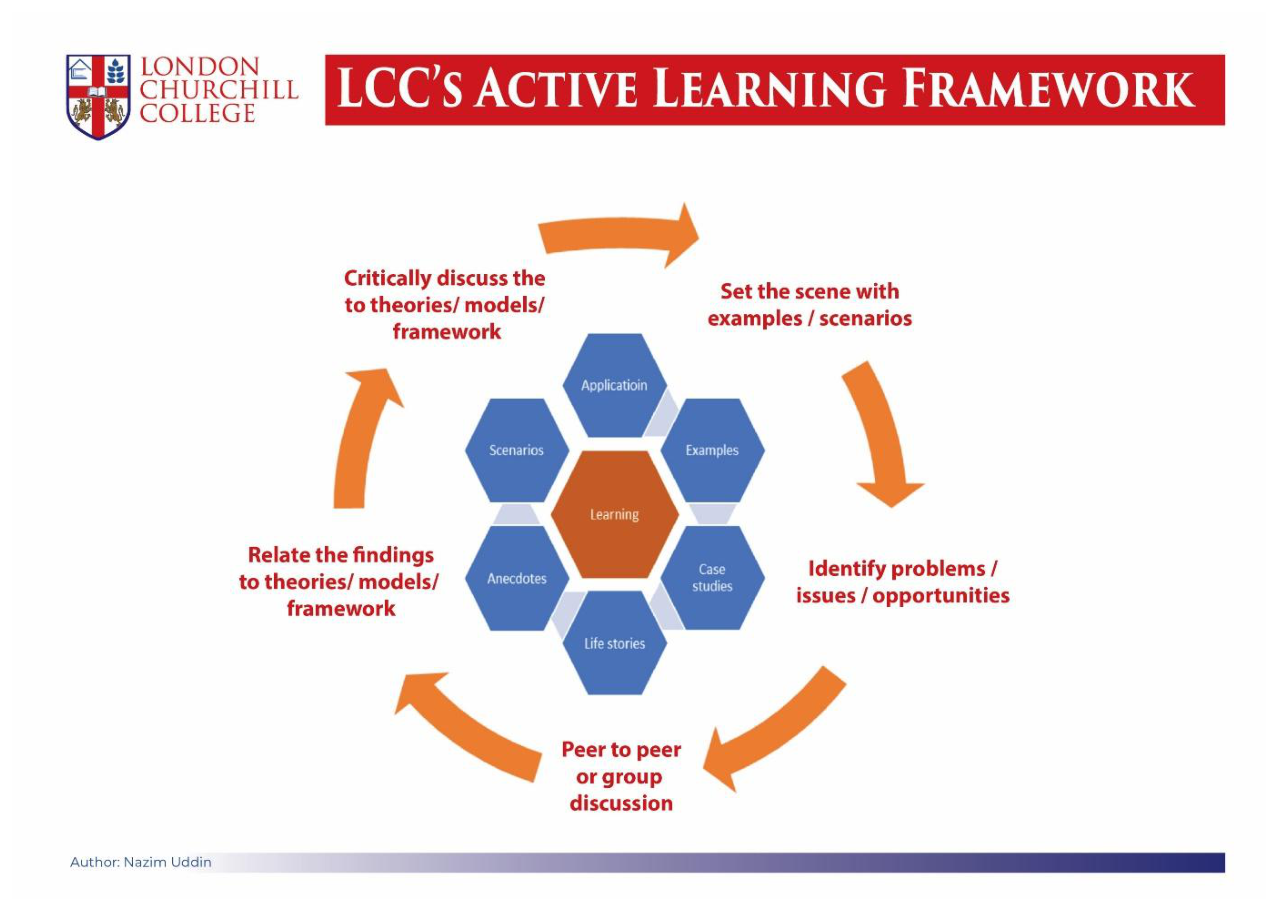
The Active Learning Framework, as illustrated by LCC’s hexagonal model, offers a robust approach to adult education by integrating diverse, experiential learning methods. At its core is "Learning", surrounded by Application, Examples, Case Studies, Life Stories, Anecdotes, and Scenarios—elements that resonate with the principles of andragogy (Knowles, 1980) and experiential learning (Kolb, 1984). By engaging adult learners through real-life contexts, this framework leverages their rich prior experiences, making learning both relevant and immediately applicable.This structured approach, underpinned by theoretical models such as Knowles’ (1980) andragogy and Mezirow’s (1991) transformative learning theory, ensures that learners engage with academic material in a meaningful, relevant, and applicable manner. By aligning theoretical knowledge with real-world experiences, ALF enables educators to create an inclusive, engaging, and effective learning environment. This alignment prepares students not only for academic success but also for professional advancement, ensuring that their education is both practical and transformative.
In conclusion, the ALF model provides a robust framework for adult learners, facilitating the integration of theory with practice, fostering critical inquiry, and creating an inclusive, student-centred environment that is adaptive to the diverse needs of mature students. The framework effectively supports adult learning by promoting engagement through varied, experiential methods that honour individual experiences and cultural narratives. Nonetheless, its success depends on thoughtful implementation and appropriate scaffolding to mitigate potential drawbacks, ensuring that the framework remains both inclusive and effective.
The Role of ALF in Enhancing Student Engagement, Learning, Retention, and Academic Performance
The Active Learning Framework (ALF) has gained prominence as a pedagogical approach designed to enhance student engagement, learning, retention, and academic performance, particularly for adult learners who draw upon their diverse life experiences and professional expertise. By shifting the learning paradigm from passive receipt of information to active participation and reflective practice, ALF enables students to become co-creators of their learning experience.
ALF’s participatory approach is instrumental in fostering deeper learning, improving retention, and ultimately enhancing academic performance. However, despite the substantial advantages of the Active Learning Framework (ALF), notable limitations warrant critical consideration. Active learning frameworks may inadvertently increase cognitive load if the diversity of methods is not sufficiently scaffolded (Kirschner, Sweller, & Clark, 2006). Moreover, a heavy reliance on peer-to-peer interaction might disadvantage those less comfortable with collaborative settings or who prefer structured guidance, and some studies suggest that while active learning can boost engagement, its impact on long-term retention does not always surpass that of traditional methods (Mayer, 2009).
Using ALF in cohort-based classes can also be potentially impractical, given that traditional higher education often follows rigid, standardised curricula that may not address the unique knowledge gaps, career transitions, or upskilling needs of mature learners. While active learning methodologies are widely recognised for engaging students, there remains limited research on their adaptability within a cohort-based, career-integrated framework that accommodates personalised learning pathways. Addressing this gap, current research explores how a cohort-based active learning framework can be designed to provide structured yet flexible opportunities, enabling mature students to tailor their education to individual career aspirations while combining the benefits of collaborative, peer-driven learning with personalised, career-oriented tracks.
A central feature of ALF’s effectiveness in promoting student engagement is its emphasis on the practical application of theoretical knowledge. Uddin (2022) underscores that adult learners tend to thrive when academic content is directly aligned with their personal and professional experiences. By integrating real-world case studies, problem-based learning (PBL), and industry simulations, ALF contextualises theoretical concepts, making them more accessible and relevant to students' lived realities. This alignment not only increases students' intrinsic motivation but also fosters greater engagement with the material. However, this emphasis on relevance may not universally appeal to all learners. For some students, particularly those with limited prior practical experience or those from diverse educational backgrounds, the application of theoretical knowledge to real-world cases might prove challenging. The assumption that all adult learners possess the requisite experience to engage meaningfully with complex case studies and industry simulations warrants further examination. Future research could investigate the varying levels of prior knowledge and experience across diverse learner populations to better tailor ALF methodologies to different student profiles. In addition to enhancing engagement, ALF significantly improves learning outcomes through deeper cognitive processing. Drawing upon Kolb’s (1984) experiential learning theory, ALF promotes a cyclical learning process of experience, reflection, conceptualisation, and experimentation. This iterative process allows students to internalise theoretical concepts by actively applying them to real-world scenarios, reflecting on their experiences, and refining their understanding. While the active participation promoted by ALF undoubtedly deepens cognitive engagement, it remains crucial to consider the potential cognitive overload that some students may face. The iterative nature of the ALF cycle could be overwhelming for learners with less developed cognitive or metacognitive skills, thereby hindering their ability to meaningfully reflect on their experiences. Research exploring cognitive load and the optimal pacing of ALF cycles for diverse learners could inform better instructional design and alleviate potential barriers to effective learning.
The role of ALF in improving student retention is particularly notable, especially for adult learners who may have faced educational disruptions earlier in life. Research supports the notion that students are more likely to persist when they perceive their education as relevant and applicable to their lives (Pascarella & Terenzini, 2005). By embedding practical methods such as case studies and peer discussions, ALF enhances the perceived relevance of the learning experience, thus fostering greater retention. However, while ALF effectively promotes engagement, there are inherent challenges in ensuring that all students feel equally connected to the learning material. In particular, learners from diverse backgrounds or those encountering external life stresses may struggle to see the immediate relevance of the content. The potential for disengagement due to external factors warrants further exploration. Future research could investigate the intersection of personal circumstances, learning motivation, and retention within the context of ALF.
Furthermore, ALF contributes to academic performance by creating a student-centred learning environment that encourages self-directed learning, reflective inquiry, and collaborative problem-solving. Knowles’ (1980) andragogical model aligns with the principles of ALF, particularly in fostering self-directed learning. By providing frameworks that encourage critical reflection and self-assessment, ALF empowers students to take responsibility for their learning. However, while ALF is designed to facilitate deep learning, its reliance on self-direction may pose challenges for students who lack strong self-regulation skills or who are accustomed to more traditional forms of instruction. The effectiveness of ALF in fostering academic performance could be compromised for these students, particularly if sufficient scaffolding and support are not provided. Further research could explore the role of scaffolding mechanisms within ALF and how these can be optimally designed to support students at varying levels of self-regulation and autonomy.
Additionally, ALF fosters the development of essential transferable skills such as problem-solving, critical thinking, and teamwork. These competencies are vital not only for academic success but also for professional advancement. By incorporating formative assessments, peer evaluations, and reflective exercises, ALF encourages continuous feedback, which in turn supports a growth mindset. However, while formative assessments and peer feedback are effective tools, their impact on academic performance is contingent upon the quality of the feedback process. Inconsistent or poorly executed peer evaluations can undermine the effectiveness of ALF in improving academic outcomes. Research could investigate the effectiveness of peer feedback within ALF, focusing on the quality and impact of such evaluations, as well as the training required to maximise their value.
In conclusion, the Active Learning Framework (ALF) significantly enhances student engagement, learning, retention, and academic performance by fostering an inclusive and dynamic learning environment. By integrating real-world applications, collaborative learning, and reflective practice, ALF creates a context in which students are actively engaged in their educational journey. However, while the framework offers substantial benefits, critical attention must be paid to the potential challenges faced by diverse student populations, particularly with regard to cognitive load, self-regulation, and the perceived relevance of content. Further research is needed to explore how ALF can be adapted and optimised for different learner profiles, as well as to examine the impact of scaffolding and feedback mechanisms in supporting student success. Ultimately, ALF represents a transformative pedagogical approach, yet its full potential can only be realised through continued exploration and refinement, tailored to meet the evolving needs of learners in an increasingly complex educational landscape.
Prospects for the Implementation of ALF at LCC
The implementation of the ALF holds promising potential for improving the academic outcomes of Widening Access Mature Students (WAMS). By integrating elements of problem-based learning (PBL), personalised instruction, and collaborative teaching, LCC could enhance student engagement, retention, and performance. The framework, informed by theories such as Kolb’s (1984) experiential learning cycle and Dewey’s (1938) emphasis on real-world experiences, aligns with existing pedagogical models that suggest active learning fosters deeper cognitive engagement. However, while the theoretical underpinnings are sound, the practical application of ALF may encounter challenges, particularly in adapting to the needs of a diverse student population that may be resistant to active learning strategies. A key concern is the potential mismatch between the pedagogical intent of ALF and the readiness of both adult educators and students to embrace this shift, which could undermine its effectiveness.
One of the primary strengths of ALF lies in its focus on personalisation and collaboration, key components that are particularly beneficial for mature students who bring life and/or professional experience to their studies. By fostering a learning environment where students can relate academic content to their real-world experiences, ALF has the potential to significantly improve knowledge retention and practical application of theoretical concepts. Yet, the effectiveness of such a framework relies heavily on substantial institutional resources, both in terms of academic staff development and the creation of appropriate technological and teaching infrastructure. Research suggests that adult educators may require considerable training to effectively deliver active learning strategies, and without adequate investment in professional development, the framework’s success could be limited (Uddin, 2023). Furthermore, the institutional commitment required to support these initiatives may strain resources.
Moreover, while ALF is likely to improve student engagement and academic outcomes, challenges remain in its implementation, particularly concerning student adaptation. Mature students, who may be more accustomed to passive learning methods, could struggle with the transition to a more active, problem-centred approach. This resistance may be compounded by other external barriers such as work commitments or family responsibilities, which further complicate the learning process. The success of ALF hinges not only on the students' willingness to engage but also on the institution’s ability to provide appropriate support structures and also the preparedness of adult educators. Many educators may lack the necessary vocational or industry experience to effectively integrate real-world scenarios into their teaching, which is crucial for active learning. Additionally, the time constraints faced by educators—often balancing heaving teaching loads with research, and personal responsibilities—may limit their ability to create the tailored, reflective learning environments that ALF requires. Furthermore, while anecdotes or life stories from students can enhance learning by offering relatable insights, they are time-consuming and risk losing the attention of a significant portion of the class. Such challenges, combined with the need for extensive individualised support for mature students, complicate the successful implementation of ALF, particularly in large or resource-constrained institutions.
The framework’s emphasis on reflective practice and personalised learning demands considerable resources to cater to the individual needs of students, which may not always be feasible in practice, particularly in large cohorts.
Conclusion
In conclusion, the Active Learning Framework (ALF) offers a transformative and progressive approach to enhancing the academic experiences and outcomes of Widening Access Mature Students (WAMS) at London Churchill College (LCC). Grounded in contemporary learning theories, such as Kolb’s experiential learning cycle, Mezirow’s transformative learning theory, and Knowles’ principles of adult learning, ALF promotes a dynamic and engaging educational environment. The framework’s emphasis on interactive learning, real-world application, and continuous formative assessments aligns with best practices for adult learners, offering the potential to improve student engagement, retention, and academic performance.
However, while the theoretical underpinnings of ALF are well-supported by research, successful implementation at LCC requires careful attention to practical challenges. These include faculty readiness, resource allocation, and the adaptability of students accustomed to more traditional, passive learning methods. The ability of educators to integrate real-world scenarios, provide personalised support, and effectively manage the time-intensive demands of active learning will be crucial in determining the framework's success. Additionally, as mature students may face unique barriers such as work commitments and family responsibilities, the college must ensure that ALF is supported by appropriate structures and resources to address these challenges.
The findings of this study provide a robust theoretical justification for ALF’s integration into higher education, particularly for adult learners, and highlight the importance of developing personalised pedagogical approaches that cater to the diverse needs of WAMS.
As ALF aims to foster lifelong learning, critical thinking, and professional preparedness, it represents a key opportunity for institutions like LCC to better equip WAMS with the skills and knowledge necessary for success in both academic and professional spheres. Future research on the ALF could utilise a mixed-methods exploratory sequential with a quasi-experimental design to rigorously evaluate its impact by comparing learning outcomes before and after ALF exposure with those obtained through traditional instruction. This approach would allow researchers to assess ALF's real-world effectiveness by providing a controlled comparison between the two groups.
Despite its promising potential, future research should focus on evaluating the long-term impact of ALF, particularly regarding its influence on student career trajectories and retention rates. Longitudinal studies will provide invaluable insights into the sustainability of ALF and its broader implications for institutional success. Additionally, further investigations into optimising resource allocation, enhancing faculty development, and refining active learning methodologies will ensure that ALF can be effectively implemented across diverse educational contexts. As higher education continues to evolve, frameworks like ALF will play an increasingly vital role in shaping inclusive and effective learning environments that prepare students for the challenges of the 21st century.
References
- Altbach, P. G., Reisberg, L. and Rumbley, L. E. (2009) Trends in Global Higher Education: Tracking an Academic Revolution. UNESCO.
- Baron, P. (2012) Business and its Environment (7th ed.). London: Prentice Hall.
- Billett, S. (2014) Mimetic Learning at Work: Learning in the Circumstances of Practice. Springer.
- Bonwell, C. C. and Eison, J. A. (1991) Active Learning: Creating Excitement in the Classroom. ERIC Digest.
- Carey, B. (2024) ‘The big idea: how the protégé effect can help you learn almost anything’. The Guardian. Available at: https://www.theguardian.com/books/article/2024/sep/09/the-big-idea-how-the-protege-effect-can-help-you-learn-almost-anything [Accessed 28 February 2025].
- Giroux, H. A. (1988) Teachers as Intellectuals: Toward a Critical Pedagogy of Learning. Bergin & Garvey.
- Kezar, A. (2014) How Colleges Change: Understanding, Leading, and Enacting Change. Routledge.
- Kirschner, P. A. and Van Merriënboer, J. J. G. (2024) ‘Scaffolding and cognitive load in learning: a theoretical synthesis’. Educational Psychology Review. Available at: https://link.springer.com/article/10.1007/s10648-024-09848-3 [Accessed 28 February 2025]. https://doi.org/10.1007/s10648-024-09848-3
- Kirschner, P. A., Sweller, J., & Clark, R. E. (2006) ‘Why minimal guidance during instruction does not work: An analysis of the failure of constructivist, discovery, problem-based, experiential, and inquiry-based teaching.’ Educational Psychologist, 41(2), 75–86.
- Knowles, M. S. (1973) The Adult Learner: A Neglected Species. Gulf Publishing.
- Kolb, D. A. (1984) Experiential Learning: Experience as the Source of Learning and Development. Englewood Cliffs: Prentice Hall.
- MacDonald, K. (2018) ‘A review of the literature: The needs of nontraditional students in postsecondary education.’ Strategic Enrollment Management Quarterly, 5(4), pp. 159-164.
- Mayer, R. E. (2009). Multimedia Learning (2nd ed.). Cambridge University Press.
- Mezirow, J. (1991) Transformative Dimensions of Adult Learning. San Francisco: Jossey-Bass.
- Onwuegbuzie, A. J., Bustamante, R. M. and Nelson, J. A. (2010) ‘Mixed research as a tool for developing quantitative instruments.’ Journal of Mixed Methods Research, 4, pp. 56-78.
- Palmer, A. and Hartley, B. (2011) The Business Environment (7th ed.). Maidenhead: McGraw-Hill.
- Pascarella, E. T. and Terenzini, P. T. (2005) How College Affects Students (Vol. 2). Jossey-Bass.
- Uddin, N., (2022) The Nelson College Experience: A Handbook of Learning and Teaching for Widening Access Mature Students. Kindle Publication.
- _______________(2023) Life experience of mature students and its relevance to leaders in making good strategic choices in higher education. In D. Baker, L. Ellis, C. Williams and C. Wragg, eds. Benchmarking Library, Information and Education Services: New Strategic Choices in Challenging Times (1st ed.). Chandos Publishing: Elsevier.
- _______________et al. (2022) Independent higher education educators in England: Tutors’ behavioural characteristics preferred by mature students on business management courses. Journal of Statistics & Management Systems, 26(7), pp. 1777-1801.
- Weatherly, P. and Otter, D. (2014) The Business Environment: Themes and Issues in a Globalised World (3rd ed.). Oxford: Oxford University Press.
- Worthington, I. and Britton, C. (2014) The Business Environment (7th ed.). Harlow: Pearson.
- Yang, C., He, L. and Bjork, R. A. (2022) Enhancing learning through retrieval practice: a cognitive perspective. Frontiers in Psychology, 13, p. 842668. Available at: https://www.frontiersin.org/journals/psychology/articles/10.3389/fpsyg.2022.842668/full [Accessed 28 February 2025]. https://doi.org/10.3389/fpsyg.2022.842668
- Zembylas, M. (2003) Emotions and Teacher Identity: A Poststructural Perspective. Teachers College Press.
How to cite
Uddin, N. (2025) ‘Enhancing Student Learning through LCC’s Active Learning Framework: A Pedagogical Approach for Adult or Widening Access Mature Students’, Journal of Contemporary Development & Management Studies, 10(1), pp. 102–114.
Converted from the printed issue (vol10-no1-2025.pdf, PDF pages 102–114). The PDF is the version of record.