Abstract
British Petroleum (BP) was responsible for a spillage of 4.9 million barrels of oil in 2013 in the Gulf of Mexico and, as one of the main oil and gas producers in the world, has repeatedly failed to keep safety margins intact. The main purpose of this article is to critically examine the corporate governance failures of the BP oil spill in the Mexican Gulf. This article represents the validation of the publicly available information to identify BP’s corporate governance regulations. Corporate governance is not only pertinent to maintaining documents, having control over finance and managing risk and performance, but also concerns itself with the organisation’s culture, values, leadership, accountability and distributing roles and responsibilities, both inside and outside the organisation. The author claims significant importance must be attributed to knowledge of those responsible for corporate governance and the identity and role played by company management and owners of the organisation.
Keywords
Corporate GovernanceFailureBritish PetroleumRisk ManagementGovernance FrameworkCSR
Introduction
The key to having a well-managed organisation must include corporate governance. Cadbury (1999) described this as ‘the system by which organisations are directed and controlled’. Corporate governance is not only pertinent to maintaining documents, having control over finance and managing risk and performance but also concerned about the organisation’s culture, values, leadership, accountability and distributing roles and responsibilities both inside and outside the organisation. It is difficult to manage all these functions in a large organisation, for example, British Petroleum. According to Calder (2008), shareholders’ rights, transparency and accountability of the board are the three main aspects of good corporate governance.
The author claims significant importance must be attributed to knowledge of those responsible for corporate governance and the identity and role played by company management and owners of the organisation. There are many different entities of stakeholder in an organisation, three of which are: management, owners, and shareholders. Managers are professionals with self-interest in getting paid for their work. To prevent managers from making decisions and possibly detrimental to the company’s interest, the system should be emplaced to check that the company has a body to oversee and deliver corporate governance.
Definition of corporate governance
The definition adopted by some authorities focuses on board’s structures and practices. Cadbury’s report on the ‘Financial Aspects of Corporate Governance’ describes corporate governance as, ‘…the system by which companies are directed and controlled…’ (Cadbury, 1992).
The OECD(2017)²² definition states, ‘Corporate governance structure specifies the distribution of rights and responsibilities among the different participants in the organisation- such as the board, manager, shareholders and other stakeholders and lays down the rules and procedures for decision-making’. Monk and Minow (1995) agree with OECD’s definition and added ‘employee’ to the relationship aspect.
Conversely, Demb and Neubauer (1992) agreed with the stakeholder viewpoint of OECD definition of Corporate Governance, excluding the term employee.
Development of corporate governance
The term corporate governance was first used by Chaucer (1342-1400). However, this term first came into popular usage in the 1980s and was adopted worldwide. At the start of the 19th century when the status ‘Limited Liability Company’ was invented, corporations were only created by the Crown or the state and people could involve in a business in three ways: sole trader, partnership and unincorporated body in some firm (Tricker, 2011). But by the 19th century, the modern corporation that could compete on equal terms with the modern state, gathered to develop a concentration of economic power (Berle and Means, 1932). Gradually, the revolution started by 1990s with a ground breaking report by Sir Adrian Cadbury on his financial aspects of corporate governance. He aimed at the listed companies and especially concerned for the standard of the corporate behaviour and ethics. Gradually ‘Cadbury Code’ was accepted for benchmarking their corporate governance structure. In the beginnings of 2000s massive bankruptcy of Enron, Worldcoms’ corporate scandal increased the interest in corporate governance. (Crawford, Curtis J., 2007). As a result the OECD put forward new principles for the Governance in 1999, revised in 2004 (United Nations, 2006), which became the internationally agreed benchmark for good practice of Corporate Governance.
British Multinational Gas and Oil Company, also known as BP PLC is ranked fifth of energy producing companies in terms of market capitalisation (PFCEnergy.com, 2013). Forbes (2012) described, British Petroleum is the sixth largest oil company by its production worldwide and the organisation has 85,700 employees, and an operating income of 19.733 billion in 2012 (BP annual report, 2013). According to BP annual report (2012), it has a production output of 3.3 million barrels per day (Mbbl/d).
On 20 April 2010, BP become concerned for about its governance board, particularly with its environmental, ethical and risk management responsibilities. The Deepwater Horizon oil rig was located in the Macondo Prospect of the GOM (Gulf of Mexico), catastrophically exploded after a well blowout. 11 people were killed and another 16 injured. The rig sank in the water after burning for 2 days. It was the biggest disaster in the history of marine oil spills (Robertson& Krauss, 2010). Before they were able to cap the well 4.9 million barrel oil had leaked. 4.1 million barrel entered in the Gulf water (The Huffington Post, 2013) and 1.8 million Corexit oil dispersant were applied (Reuters, 2012).
The author of this article claims the chairman and board of directors were responsible for the Deepwater Horizon disaster. The board’s responsibility was to set the company’s strategic aims and to use its leadership to deliver these aims. It is of concern that after the deep water horizon disaster, the question arises of whether management is performing its governance responsibly. In this article the author will critically analyse the governance board, its corporate risk management policy and CSR.
Selected Literature Review
In this Literature Review the author describes the theories and philosophies of Corporate Governance developed over time by many researchers and scholars.
Agency Theory
The agency dilemma argues that there is always a fundamental challenge underlying in all corporate governance affairs. Indeed, it is not something new. Adam Smith (1776), described in his “The Wealth of Nations” that:
“The directors of companies, being the manager of other people’s money cannot be expected to watch over it with the same vigilance with which they watch over their own.”
This is a problem of agency. This problem is often a sever issue in listed companies. As they start to grow their shareholders become diverse, and this occurred at British Petroleum. As Berle and Means (1932) showed in their influential analysis that:
“…as Listed companies grow and their shareholders become more diverse the separation between owners and directors increased and power shifted towards the directors, which some of them abused.”
So, a Corporate Governance relationship is a contract between shareholder (The Principle) and the Director (The Agent). In agency theory it is argued that directors seek to maximize their own benefit, to take actions that are advantageous to themselves but detrimental to the shareholder. Bob Monks (2008)argues that: “trillions of dollar of shareholders wealth have been wrongly extracted from US corporations over the year by directors abusing their power”.
Stewardship Theory
In practice managers run the day-to-day business in any organisation. They know the business’s internal strengths and weaknesses. According to that point of view, managers can become good stewards of the business and the organisation because of their trustworthiness, high corporate profits and shareholders’ returns which they worked diligently to accomplish (Donaldson and Davis, 1994). The steward’s cooperation and a “goal alignment “(Davis et al., 1997) means that they can work closely with the Principals to achieve their goals.
Benchmarking
Benchmarking means to identify “Best Practice” and this process includes; Understanding existing business practice at BP, analysing their practical processes against their standards and then comparing that to the theory of best practice. Below the author gives his view of best practice depending on that. In this report, three corporate governance issues are highlighted.
Corporate Risk Management
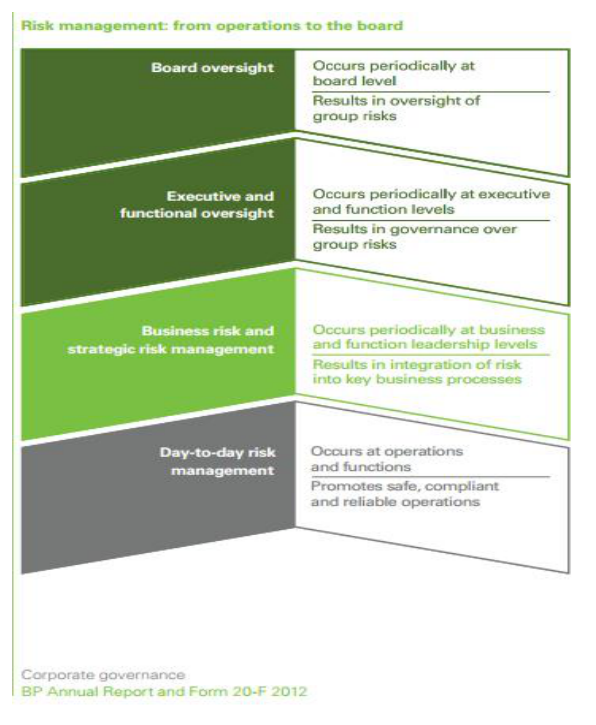
According to the 2012 Annual report of BP, their risk management system has three level of activity (Diagram shown in Appendix 1).
Day To Day Risk Management
Day to day risk management facilitates management on an everyday basis at the operational and functional level of the business. Any types of threat need to be identified and managed through the right team and at the right time to prevent future risk events. Addressing different types of risk on a daily routine basis is the central to the company as oil is a dangerous substance.
Business and Strategic Risk Management
At BP any business and business function related risk need to be collated periodically to assess and take necessary further improvement and actions to be planned. This periodical system is designed in a standard way that is known as RMR or ‘Risk Management Report’ for the business and the function is to inform continuously regarding the risks they face.
These undergo management consideration, resource allocation, intervention, and challenge. The policy allows them to integrate their business processes like strategic planning, performance measurement, allocation of resources and project appraisal.
Board, Executive, and Functional Oversight
Executive and board oversight and responsibility for the risk management system facilitates the regime and is essential. It needs the attachment of the executive team in the finalisation of risk management and development of the group. In line with bottom-up meets top-down executive summary of the risk assessment and evaluation process, using a system that requires monitoring, is needed to identify the key risks. An effective board will regularly review mistakes and the related management of these risks.
Despite having a very strong risk management policy at BP, how it was possible to have that Deep-water disaster at the Gulf of Mexico is a mystery. Tony Hayward, BP's former Chief Executive Officer argued that the explosion and oil spill can occur at any oil company and BP was just unlucky. But the history of BP’s carelessness proves that this was not their bad luck, but their mismanagement at identifying risks. In 2005, BP’s Texas City oil refinery had an accident which killed 15 people and injured 180 people. That accident cost BP $2 billion in lawsuits and damages. The investigation shows that after BP acquired the refinery the CEO cut operating costs and, as a result, already poor maintenance and safety standards were further reduced. The following year another incident occurred at Prudhoe Bay, Alaska where a burst pipe spilled 200,000 gallons of crude oil. Further investigation showed that to save money the company stopped cleaning and testing the pipeline and as result, the incident happened (Korosec, K. 2010).
Hayward and his words implies that the company was now seriously at fault. The reports from these incidents suggest safety was compromised as a result of cost savings. These reports were apparently ignored by the new board of BP and by Hayward. In the three years that he was the CEO, the company reduced its overhead costs by a third by cutting 7,500 jobs worldwide and reducing operating costs by $ 4 billion in 2009.
BP has claimed to be focused on safety issues, but it appears to be more clearly focused on cost cutting at the expense of safety. So, it can be concluded that being unlucky is not an excuse. BP was not delivering what it states in public.
The BP Board
BP follows a unitary board structure that is characterised by one single board comprising both executive and non-executive directors. This unitary board is liable for any aspect of the organisation's activities and all Directors are working for achieving the same goals. At the company’s Annual General Meeting shareholders elect the Directors for the Board.
BP Governance Framework
The BP Board system starts with the Board and reflected in the governance of their offices. The hierarchy is summarised in BP board governance principles as part of the board, the Board’s processes and relations with management (Bp.com/governance),
BP Board’s Core Activity²³ involves:
- Long term strategy is actively considered.
- Operating procedures and monitoring the performance of BP
- Ensure that significant risks that have been identified in the BP-reducing risks and risk management system.
- The continuous and executive succession planning.
Role of Chairman
The role of the chairman, Carl-Henric Savnberg, is to provide leadership of the board and to communicate between the directors and the chairman. The President speaks on behalf of the shareholders and Board of Directors with precise instructions in a timely and clear manner (BP Annual Report, 2012).
Non-Executive Directors
The guiding principle for Non- Executive Directors is that they are independent in character and judgment, and free from any business or other conditions that may interfere with the exercise of their duties. The Board has decided that they should have independent Non- Executive directors, and these have served since 2012. They believe that there should be no compromise when it comes to board Freedom, or the existence of a conflict of interests with Directors serving on outside entities outside agencies have other appointments. These issues are considered at each board meeting. A Nomination Committee determines the nature of the other interests, the director fee notes Plate performance is not hindered. (BP annual Report, 2012)
Weaknesses of the Governance Board of BP
According to the data provided by the BP Annual Report in 2012, it is positive to some extent. They believe they have been serving the organisation by raising all of their concerns. However, how was it possible to have 3 disasters including the Deepwater Disaster in the Gulf of Mexico?
BP’s Governance Board structure and governing principle collapsed in the wakeup call of Gulf of Mexico. Instead of providing new leadership BP sent Tony Hayward to placate its major partners and stakeholders. Removing him should have been the first step when the disaster happened. This would have made it easier to win partners and stakeholders back while they worked on stopping the leak in the Gulf of the Mexico. The Financial Times noted at the time, “There is no question that top management will have to be changed following the Gulf of Mexico oil spill." It was also noted BP's response "exposed shortcomings in leadership and presentation" (Marcial, 2010)²⁴. Analyst Lucy Haskins of Barclays Capital explained, "There are serious corporate governance questions" given the magnitude of events at BP, which she describes as "structurally disadvantaged”. The terms of responsibility and corporate governance program they addressed in their book are ranked third by the experts. However, if they rank what BP’s Governance Board accomplishes against their responsibility, then there would be a new ranking. The author believes governance should be based on morality "Acts". as part of the day-to-day operations of the company.
Olsen (2005) points out that British Petroleum is more disaster-prone than other oil companies and the recent Deepwater disaster proves that again (Casselmain, 2010).
A review by Tony Jackson of The Financial Times found that British Petroleum’s stable corporate culture is difficult to change and has a poor safety culture. The BP Annual Report claims that its priorities are safety, however, there is little evidence to support this statement, as can be seen from the refinery explosion in Texas and the Gulf of Mexico oil spill. Jackson further states a British Petroleum BP has a rigid corporate culture, which is difficult to change and has a poor safety culture. BP annual reports include its priorities are safety, but this has to be questioned, as seen from the refinery explosion in Texas and the Gulf of Mexico oil spill.
Corporate Social Responsibility (CSR) and Sustainability
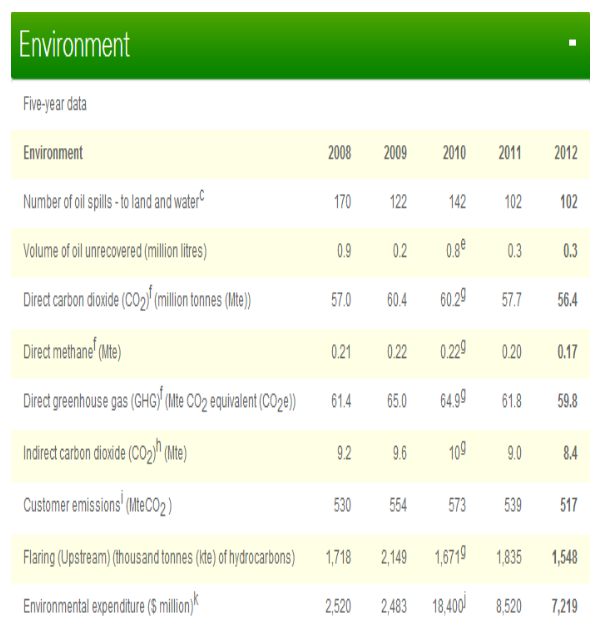
BP has a long history of oil spill accidents since the 1990s, which have cost many lives and caused considerable damage to the environment. On 23 March, 2005 there was an Explosion at BP’s Texas City refinery; in March and August 2006 there were two leaks at BP’s Prudhoe Bay oilfield in Alaska; on 29 November, 2009 its pipeline leaked nearly 30,000 barrels of oil per day at Lisburn field in Alaska, adjacent to Prudhoe Bay Field. These cases, in addition to the Deep-water horizon disaster, all suggest that BP has little concern about the environment and its corporate social responsibility²⁵
The Deepwater horizon oil rig explosion spill was catastrophic and had long-term effects on wildlife, fisheries and tourism in the surrounding areas. In response, BP established a crisis management program. Tony Hayward publicly apologised for the damage caused and promised that BP would pay the costs of the clean-up as well as compensation for the direct victims and those impacted. The company currently has a $20 billion responsibility to this end. BP also spent considerable resources and tried a variety of techniques trying to stop the leak²⁶.
Moreover, according to its report, BP is working on researching reducing the carbon in oil. BP is also investing in biofuels and wind as well as in new technologies that could create new options for growth. BP plays a leading role in distributing natural gas and is working with the US, Trinidad & Tobago, Indonesia, Algeria, Oman, Egypt, China, and India to develop a supply chain for natural gas as it has lower carbon than oil. BP is also playing a leading role in building and personal development of staff. BP has invested $500 million in employee training and capability building, with 91% more graduates recruited than the year 2009²⁷.
This shows that BP is beginning to take social responsibility and ethics more seriously.
Recommendation
BP’s report on the deep water horizon accident describes eight causes of the disaster. These include the failure of the cement in the well to the failure to divert gas away from the rig, to the explosion and the failure of the blowout preventer. BP suggests these eight “Causes” were the fault of its contractors.
According to the discussion within this paper it can be concluded that BP needs to improve in a number of ways. Firstly, it has improve safety measure/risk management and need significant improvement in the factors below:
- Development of standards. Better and clearer processes for a range of activities including cement leakage, test drilling, to better control and manage risk in this area.
- Significant improvement in training and education of BP employees to improve their capacity and competence.
- Strengthen audit processes for improving measures of output, and close control to remedy deficiencies in audits.
- The implementation of stronger oversight of contractor’s current practice with regard to cementing, well control, process safety, design of platform blowout preventers and preventive safety.
- Development of customers and other processes including the identification of key indicators.
Secondly, BP need changes to its Governance Board System. Even after the Deepwater disaster in 2010 the new chairman of the board, Hayward Carl-Henrick Svanberg was absent with his new partner. He did not show up when the organisation actually needed him as the disaster ensued, but arrived somewhat later, on the way back from a holiday in Thailand. Later on 28 July 2010, he stepped down as CEO.
Questions were asked about how it was possible that the board chairman was away on holiday during a global catastrophe.
Another issue of BP governance is its safety culture. BP is weak in maintaining safety and as a result, suffers repeated disasters. The author recommends that BP should follow the OECD principles of Corporate Governance, which are:
- Strategic guidance and effective monitoring of management by the governance board and board’s accountability to the company and stakeholders;
- All material is transparent and timely including financial, performance, ownership and governance situation;
- An annual audit by the independent external qualified auditor.
- Also, additional recommendations for BP should also include:
- Not reducing the budget for safety maintenance and more importance is placed on risk assessment and analysis. Any issue should have quick decision and risk be prevented at an early stage.
- Directors’ remuneration should be investigated. The agency theory of Governance suggests that directors may become overly self-interested and may make decisions that will be detrimental to BP’s shareholders.
Appendix 1
Appendix 2
References
- BBC, (1998). “Business: The company file from Anglo-Persian Oil to BP Amoco” at http://news.bbc.co.uk/1/hi/business/149259.st, Retrieved on 27th of November 2013.
- Cadbury, A. (1992). “Foreword to Corporate Governance and Development”, Global Corporate Governance Forum, World Bank, Washington D.C., 2003, pp. v-vii
- Crawford, Curtis J. (2007). The Reform of Corporate Governance: Major Trends in the U.S. Corporate Boardroom, 1977–1997.
- Davis, G. F. & Thompson, T. A. (1994). 'A Social Movement Perspective on Corporate Control', Administrative Science Quarterly, 3
- Davis, J. H., Schoorman, F. D. & Donaldson, L. (1997). 'Toward a Stewardship Theory of Management', Academy of Management Review, vol. 22, no. 1, pp. 20-47.
- Demb, A. and Neubauer F. (1992). The Corporate Board: Confronting the paradoxes. New York: Oxford University Press
- Forbes.com, (2013). at http://www.forbes.com/pictures/mef45ikjd/6-bp-4-1-million-barrels-per-day-13/, Retrieved on 27th November 2013.
- Himler, F.G. (1993).Strictly Boardroom: Improving Governance to enhance Company performance. The Sydney Institute and Information Australia, Melbourne, Australia.
- Jackson, T. (2010). BP must ensure its good intension become reality. Financial times, 27 June, at http://www.ft.com/cms/s/0/5b89e194-820a-11df-938f00144feabdc0, Retrieved 27th November 2013
- Korosec, K. (2010). “BP’s History of Oil Spills and Accidents: Same Strategy, Different Day”.http://www.bnet.com/blog/clean-energy/bp-oil-spill-probe-finds-one-hot-mess-8212-or-seven-causes-behind-the-gulf-disaster/ 1844. Retrieved on 27th November 2013
- Kunzelman, M. (2013) “BP Seeks Gulf Oil Spill Size Ruling from Judge” at http://www.huffingtonpost.com/2013/01/12/bp-seeks-judges-ruling\_o\_n\_2459184. html, Retrieved on 27th November 2013.
- Monks, R.A.G. and Minow, N. (1995). Corporate Governance. (2007) 4th edn. Chichester, UK:Wiley.
- PFCenergy.com, (2013). at https://www.pfcenergy.com/PFC-Energy-50/PFC-Energy-50, Retrieved on 27th of November 2013.
- Phan, P. H. (2001). 'Corporate Governance in the Newly Emerging Economies', Asia Pacific Journal of Management,18:2, pp. 131-136.
- Phan, P.H., Lee, S.H. & Lau, S.C. (2003). 'The Performance Impact of Interlocking Directorates: The Case of Singapore', Journal of Managerial Issues, 15:3, pp. 338-352.
- Robertson, Campbell, Krauss,& Clifford (2010). "Gulf Spill Is the Largest of Its Kind, Scientists Say". The New York Times. At http://www.nytimes.com/2010/08/03/us/03spill.html?\_r=0. Retrieved 17 November 2013.
- Smith Adam (1976). “The Wealth of Nations”. Revised Edition, George J. Stigler (ed.), Chicago:University of Chicago Press.
- The Telegraph (2012). “A history of BP's US disasters” by Reuters at http://www.telegraph.co.uk/finance/newsbysector/energy/oilandgas/9680589/A-history-of-BPs-US-disasters.html. Retrieved on 27th November 2013.
- Tian, J.J. & Lau, C.-M. (2001). 'Board Composition, Leadership Structure and Performance in Chinese Shareholding Companies', Asia Pacific Journal of Management, vol. 18:2, pp. 245-263.
- Tricker B. (2011). “Governance and Management”, Corporate Governance: Principle, Policies and Practice, Ed 8th, pp.29-30
- United Nations, (2006) “United Nations Conference on Trade and Development” at http://unctad.org/en/docs/c2isard31\_en.pdf. Retrieved on 27th of November 2013.
- US to give BP evidence on size of Gulf oil spill. Chicago Tribune. Reuters. 11 April 2012. At http://articles.chicagotribune.com/2012-04-11/news/sns-rt-bpoilspilll2e8fblta-20120411\_1\_deepwater-horizon-bp-plc-oil-spill. Retrieved 27 November 2013.
Notes
²¹ PhD Candidate
²² Organisation for Economic Co-operation and Development
²³ Source: (BP annual Report, 2012)
²⁴ Gene Marcial, financial columnist in Daily Finance, 7/12/2010.
²⁵ The Telegraph, 2012.
²⁶ Source: BP.com, 2013.
²⁷ Source BP.com, 2013.
How to cite
Sunny, A.A. (2017) ‘British Petroleum deep water horizon disaster: Critical analysis of corporate governance failure and the search for a solution’, Journal of Contemporary Development & Management Studies, 5(1), pp. 33–39.
Converted from the printed issue (vol05-no1-2017.pdf, PDF pages 32–38). The PDF is the version of record.