Abstract
This paper explores issues arising in university business school leadership in response to a changing environment through the lens of respondents’ stories (dialogic discourse). Focus is placed on respondents’ organisational stories, myths and perceptions of events in their respective business schools. The research design utilises case-study strategy, drawing from stories of leadership undertaken in three university business schools and presents a thematic reflection based upon summaries provided by twenty participating respondents including Executive Deans, Professors and Lecturers.
Findings indicate that a discontinuity exists within business school leadership characterised by a climate of insecurity and instability caused both by the external environment and multiple regulatory frameworks, combined with internal short-term reactive interventions in direction and personnel. The respondents’ workplace experiences and observations that emerge from the research contribute a rich source of new material in contemporary knowledge worker environments. For example, respondents, both in management groups and teaching, working in different business schools, share a sense of being out of control in respect of events. Accordingly, stories of repeated turnarounds in strategy, appear to have seeped into the organisational cultures of the cases studied. Hence, the title of this paper is taken from an interview with a business school Dean who described his/her leadership experience to be like: ‘riding a tiger backwards’.
The paper provides new research into the challenges of leadership and collegiality in a transforming Higher Education environment. The research provides insights into environments in flux, with the consequential uncertainties. Accordingly, the research supports the adoption of a more reflective leadership style that listens to alternative narratives and thereby nurtures a more consultative academic community and student learning environment. This would require organisational commitment to building supportive and stable business school communities.
Keywords
LeadershipDialogic DiscourseOrganisational Strategy
Introduction
In 2019 the HE sector has already been in a perfect storm of external and internal uncertainties for several years. Those forces are adversely impacting on student recruitment and revenue streams, thereby generating a turbulent and uncertain environment for academics and their leadership teams. Government policies for nearly a decade (The Liberal Democratic and Conservative coalition government followed by the Conservative administration) include international students in their immigration figures, placing increasingly higher bars for international student entry into UK Higher Education (Saunders & Nieto, 2014). Brexit uncertainty continues to foster student recruitment uncertainty from the EU. The tuition fees and loan system for UK students remains in place. New requirements from accrediting and regulatory bodies require academics to spend a larger proportion of their time filling in forms. The increasing number of metric centric interventions could almost fill an alphabet of acronyms, to list just a few here: AACSB, AMBA, BSIS, EQUIS, EPAS, HEA, QAA, REF, TEF.
Internally, financial pressures on universities prompt them to use, some would argue misuse, their business schools as cash generators for other university projects. Such financial challenges increase the pressure on academics to generate revenue and for those in leadership to become focused on reducing costs and increasing income.
The research for this paper offers the frank perspectives and observations of people in academic leadership posts and their colleagues who are tasked with responding to internal and external pressures within a context of regular changes in management teams. Respondents reported having twelve Deans/ Directors in ten years and the consequential turbulence caused. Then, at Head of Academic Department level, respondents spoke of changes annually. All of these external and internal factors make leadership in a business school a very challenging role.
The paper reports on stories (dialogic discourse) from twenty academic respondents in three case studies and evaluates why respondents have communicated distress, disengagement and disorientation in their business schools. The aim of this paper is therefore to present new findings on academics’ perceptions of where they think they are being led and how they are being led, within a context of a transformational environment.
Our paper is therefore of interest to the higher education community and also for others working in other knowledge intensive contexts.
Literature Review
The transformative post 18 educational twenty-first century environment means that in order to remain relevant, business schools have to adapt and change their offerings to prospective learners and the wider society. HE providers need to become transformative hybrids of what might be regarded as either a public or private HE in order to succeed in a competitive and changing HE environment (Nieto and Bisschoff, 2015). Hence in order to address complex situations an organisation needs to nurture collaborative collegiate engagement (Grint,2010; Mabey, 2013, Nieto, 2014). In academia this would require an organisational climate that values talents and encourages engagement in the academic community. However, according to Knights and Clarke (2014, pp 335-357) the almost constant auditing detracts attention from core learning and income generating activities such as teaching, enterprise and research. Indeed, it can also demotivate academics by compelling them to write long and complex documents, for multiple accrediting and regulatory bodies. This is pertinent to the leadership of HE because of consequential tensions and rifts in trust in personal relationships between people in HE leadership posts and their colleagues (Finch et al, 2016).
In the particular case of business schools, the ambient level of managerial theoretical knowledge is likely to be more commonly part of the staff discourse than might be the case in other university faculties (Allix and Gronn, 2005). This also has interesting implications for the study of tensions, dissonances, or synergies between knowledge of theory and the practices which respondents observe in the working environments.
In evaluating the literature, it becomes evident that the social context should be included in what counts as knowledge in the study. For example, Peck and Dickinson (2009) argued that leadership should be viewed through the lens of its social context and, furthermore, that behavioural norms and organisational culture have significant bearing upon how people lead or follow. In support of the significance of contextual knowledge, Peck and Dickinson (2009) observed that leadership can be expressed simultaneously as formal and informal and that persons can serve as both leaders and followers, depending on the situational context.
Accordingly, the stories, which the respondents share, provide filaments of illumination, not just of how they are being managed, but also of the ethos, culture and values of their organisations (Gabriel, 2010). It thereby follows that the stories which respondents share opens a view into both the consciously and perhaps unconsciously transmitted values of their universities.
The model below identifies three different types of organisational problems and proposes that each requires a distinct leadership approach. The proposition is that whilst the uncertainly which HE currently needs to address requires a collaborative leadership approach, the more commonly applied leadership interventions are Tame, (Metrics/ procedures / Processes) and Critical Command (Command/ Control). This is because organisational cultures are inclined to hire and promote those whose ideas align with the status quo and reject employing or eject those who challenge their perceptions of leadership. For example, if the university is metric orientated, then those whose default leadership response is to create more metrics/ procedures / processes are more likely to be employed /promoted, even if the approach does not address the complex situations that they need to address. As a consequence, if a person in a leadership position is inclined towards a preferred leadership approach, that individual may, albeit inadvertently, misinterpret the typology of the problem to suit their preferred personal leadership approach. This is even more likely if the organisation rewards that particular approach.
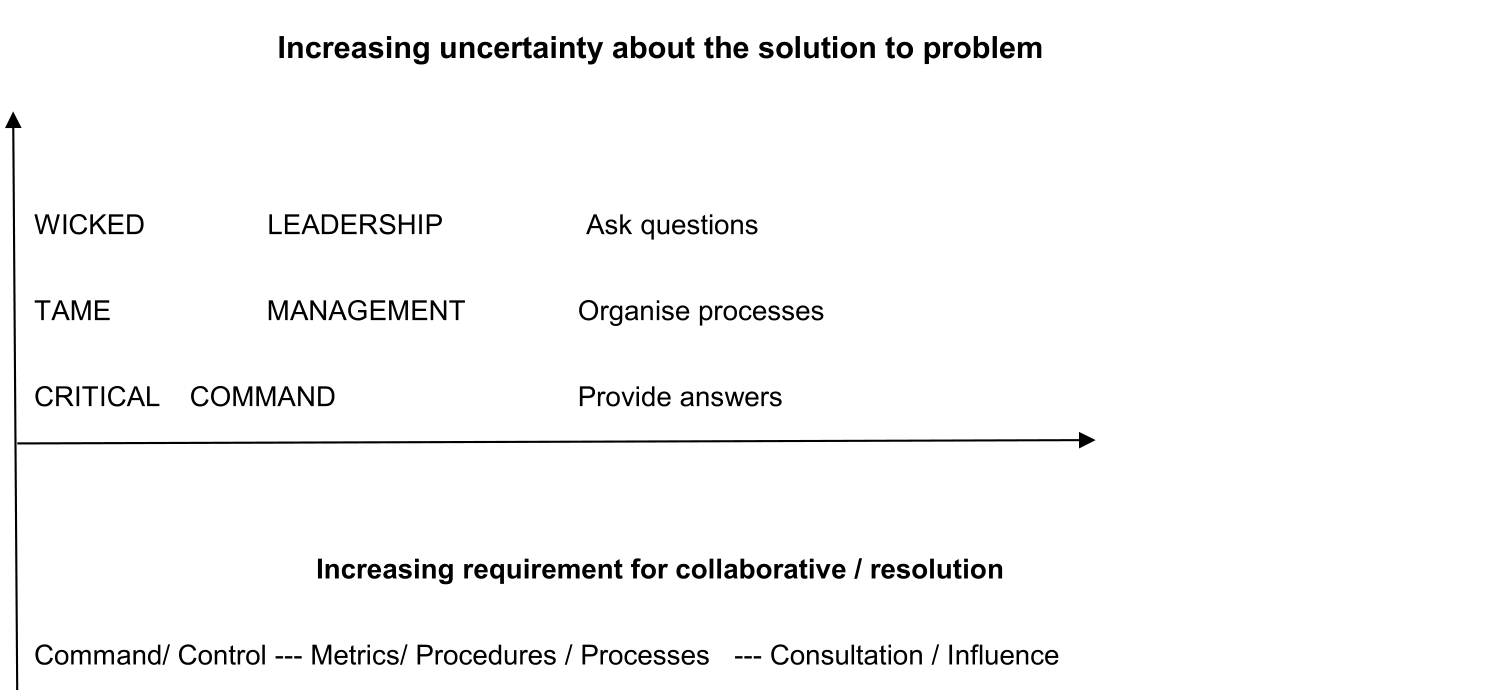
Nieto and Saunders (2019), developed from the model of contemporary leadership situations by Grint, Typology of problems power and authority (2010)
Research Design
A case study approach strategy was adopted. (Denzin and Lincoln 2000a; Denzin and Lincoln 2000b; Yin 1994a; Yin 1994b). The research focused on academic respondents from three business schools selected as case studies that were chosen from the list of post 1992 universities. In selecting to review the data for this paper through the lens of dialogic discourse, the analysis has uncovered a rich stream of images, experiences and events, which form a pattern of how the respondents’ view their workplace environments. The research thereby offers valuable new insights into a complex knowledge worker context. For example, according to the work of Gabriel (2000, p.5),
‘Stories in organisations are relatively special narrative phenomena competing with other types of discourse including theories, statistics and reports.’
The approach described in the work of Gabriel (2000) draws upon the dialogic discourse, which places the focus of the research upon the stories told by respondents. Accordingly, Russell and Kelly (2002) observed that dialogic research does not seek to find pre-existing truths, whatever truth might be. Instead, it considers meanings, which may surface through an interactive dialogue between the researcher and the respondents and reveal patterns of individual or sometimes collective iconographies of organisational perceptions of people, events and organisational situations (Morgan,1997).
The study of the respondents’ leadership stories (Gabriel and Griffiths in Cassell and Symon, 2004, p.114), can encourage respondents to tell how leadership works in their organisation, what kinds of leaders are well regarded or not, the kinds of behaviours that tend to get people promoted, and why they believe this to be the case.
To undertake the research study, the author sent a preparation letter to prospective respondents and a consent paper whereby they could, if they wished, have their answers removed. All interviews were recorded with the respondents' consent, and any information that could identify them was deleted to protect the respondents’ anonymity.
Subsequently, recordings were given to a professional academic transcription company that specialises in faithfully transcribing exactly what was said during the interviews. Consequently, they were actually written down word-for-word according to what the respondents had said during the interview process.
The reason the respondents sound more relaxed than they would be in a formal meeting is, because they had been assured of anonymity prior to the interviews, they were more willing to express individual opinions than would have been the case had they been associated with HE managerial positions at particular levels within Higher Education Institutions. It was important to record what the interviewees believed to be happening, rather than to reflect the positions of particular organisations.
Findings
The respondents share illuminating stories about their experiences. The metaphors and stories, which emerge from the research, surface emotions and irrationality of some of the decisions senior managers are reported to have made (Albrow,1997). In these findings the voices of the respondents present their perspectives of leadership in their universities.
Like riding a tiger backwards
‘And I always describe xxxx like riding a tiger backwards, it’s very fierce, it goes very fast, you don’t know where it’s going and you can’t get off.‘
Top down directives
‘All these demands and constraints on you from the centre, often by pro-vice-chancellors and vice-chancellors who for them, leadership is: ‘oh I’d like you to do that’, and they don’t think through the operational logistics of it.’
New building approved but funded by 17% academic staff cuts
‘And so, a famous story … the [Vice Chancellor] came around to the idea, and we eventually got a commitment to spend about £xxxx million on the site. Then there were the cuts that were required, and they were absolutely appalling because there was me trying to build a business school and expected to achieve a 17% cut in one year in budget expenditures; so that was horrific.’
Like keeping the wolves from the door.
‘The fact that I was seen fighting tooth and nail for my staff; it was targeted at people who were mid to late career. I’d [tried to] keep the wolves from the door, I think it was appreciated.’
Like a budget airline.
‘So, in a way, there are some and not just post 92 [universities], but the majority of post 92’s have been [the] Ryanair of education …it doesn’t matter how badly you treat your customers, there’s always a supply of new customers.’
Like a marriage that’s keeping up appearances
‘We are still marketing it as if we were together [a collaboration between two universities], …because I felt that if people learned from outside that something is wrong it’s like in a marriage if someone learns something is going wrong they wouldn’t really want to come.’
Three rounds of redundancies in eight years
‘In the eight years I’m now one of the oldest members here, [circa around mid-forties years old] not only in age but in tenure. It didn’t used to be. Redundancies – we’ve had at least three rounds.’
Sold down the river
‘Now we’re having a high turnover of staff because they’re sold down the river. [They are told] this is a research led university. We’ll be like a Russell Group, and you’re mainly going to be doing research, and that’s what we’re bringing you on board for. They come in and find out that it’s mainly a teaching university and then they stay here for about a year and look elsewhere.’
Like the King and Queen in their tower
‘[senior university leadership] are not a part of the staff. [Their offices are] separate and higher up than us – like they are looking down, and I think there’s some irony in that. It’s like the king/queen in their tower looking down on his/her minions, which I just think is the wrong approach to have actually.’
Academics as factory workers
‘It reminds me of a traditional manufacturing environment where you’ve got the factory shop floor and all the workers are doing their job’
Top-down leadership
‘As you go up a floor in the building the more senior you are the higher up the floor you go.’
Slash, burn and run away
A Dean’s perspective on leader behaviours caused by short-termism, insecurity of tenure for senior managers on the business school’s policies and procedures.
‘Some people have the slash and burn approach as well, where they just go and do something very dramatic and then run away before everything, all the pieces fall back down [laughs].
BBQ invitation
The respondent reported the story of a new Dean who stated that s/he had no interest in staff that they may dismiss.
‘With one Dean in particular, a member of staff went in to welcome him/her and said did [s/he] know anybody in the area, to which the [Dean] said no and s/he said well don’t worry, we’re a sociable bunch, we’ll invite you to social do’s, [as] summer [i]s coming up. People have BBQs. To which s/he heard the reply, I don’t socialise with people I may have to fire.’
Command and Control
‘A fairly managerialist sector, the Vice Chancellor and similar senior people’s perception of distributed leadership is of command and control.’
Like working in a washing machine
‘[Working in the business school was] …just like being in a washing machine the whole time, never knowing when anyone was going to open the door.’
A problem getting anybody to do anything
‘They [managers] had a problem getting anybody to do anything, because everybody was so disaffected. People were so permanently stressed out. So really, they couldn’t get people to do their jobs.’
Conclusion
The respondents from different cases offer similar perceptions of reality in the stories they share, regarding an unsettling sense that they have no control over what is happening within an environment where others exert power over their academic careers, often without consultation. Senior leadership is reportedly a significant contributor to the problems in the cases studied. However, this perception requires further analysis. Why are senior managers reportedly behaving in this way? Is HE management constrained by so many regulatory frameworks that it is not, in practice, possible to take another direction? Is there a selection and retention issue, whereby people with different leadership approaches are not appointed, promoted or retained? The reported short tenure in post of Deans and Heads of Department (sometimes less than a year) also surfaces the need for more coherent stability in leadership. Moreover, consultative leadership could address some of the challenges which respondents identified in their working environments.
A key challenge for leadership is the reported predominance of Tame and Critical/ Command approaches. Thereby underutilising a Consult / Influence response to the current complex challenges facing the sector. Yet the stories shared by respondents indicate that Tame and Critical / Command leadership approaches are not addressing the current challenges which HE is facing, as demonstrated by the reported disengagement, short-termism and high levels of staff turnover in management, combined with academic redundancies. Indeed, the number of metric centric interventions appears to be seen by respondents as part of the problem, than the solution.
A decline in student numbers and revenues as discussed in our introduction is a key challenge for the sector. This can be partly attributed to the increased competition for students and the external factors. Yet respondents, both in senior management positions and lecturers reported that the actions which their universities had taken had in their perceptions not addressed these complex situations. To conclude, whilst HE institutions cannot change the external storms they face, it is in their control to improve how they care for their communities of academics and students.
References
- Albrow, M. (1997) Do Organisations Have Feelings? London: Routledge.
- Allix, N. & Gronn, P. (2005), Leadership As A Manifestation Of Knowledge. Educational Management, Administration and Leadership, 33(2) 181-196.
- Denzin, N. K. & Lincoln (Eds) Y.S. (2000a) Handbook of Qualitative Research. (2nd Edition) California: Sage Publications.
- Denzin, N. K. & Lincoln (Eds) Y.S. (2000b) Strategies of Qualitative Inquiry. (2nd Edition) California: Sage Publications.
- Finch, D., Deephouse, D. L., O’Reilly, N., Massie, T., Hillenbrand, C. (2016) Follow the leaders? An analysis of convergence and innovation of faculty recruiting practices in US business schools. Higher Education, 71 (5) pp 699-717.
- Gabriel Y. (2010). A space for ideas, identities and agonies. Organization Studies, 31, pp 757-775.
- Gabriel, Y (2000) Storytelling in Organizations: Facts, Fictions, and Fantasies. Oxford: Oxford University Press.
- Grint, K. (2010) Wicked Problems and Clumsy Solutions: The Role of Leadership. Cranfield University, pp 129-141.
- Knights, D., & Clarke, C. A. (2014) It’s a bittersweet symphony, this life: Fragile Academic selves and insecure identities at work. Organization Studies. March 1 pp 335-357.
- Mabey, C (2013) Leadership Development in Organizations: Multiple Discourses and Diverse Practice. International Journal of Management Reviews 15 (4) pp 359–380.
- Morgan, G. (1997) Images of Organisation. (2nd Ed) London: Sage.
- Nieto, M. L., and Bisschoff, T (2015) Leadership and followership in Post-1992 University Business Schools in England, Chapter in the Handbook of Research on Administration, Policy, and Leadership in Higher Education. IGI Global.
- Nieto, M. L., (2014) Human Resource Management. Basingstoke: Palgrave/ McMillan.
- Peck, E. & Dickinson, H. (2009) Performing Leadership. Basingstoke: Palgrave McMillan.
- Russell, G. M. & Kelly, N. H. (2002) Research as Interacting Dialogic Processes: Implications for Reflexivity [47 paragraphs] Forum: Qualitative Social Research, 3 (3).
- Saunders, B. & Nieto, M. L (2014) in “Global Talent Management - Challenges, Strategies, and Opportunities”– Series Management for Professionals. Editor Dr Akram Al Ariss, Université de Toulouse, Toulouse Business School, France. Springe.
How to cite
Nieto, M. (2019) ‘Editorial: Riding a Tiger, Backwards. A dialogic case study of contemporary Leadership in Business Schools’, Journal of Contemporary Development & Management Studies, 7(1), pp. 6–13.
Converted from the printed issue (vol07-no1-2019.pdf, PDF pages 8–15). The PDF is the version of record. Text was recovered by OCR from an outlined-text PDF; check against the PDF before citing.