Abstract
More than 150 years ago, Karl Marx, a philosopher and revolutionary thinker, initiated many theories that still influence contemporary discussions of society and social systems. His works generated many critical questions and revolutionary ideas that are still relevant in the current world. To understand the social system and its education, we need to know the ideas of Marx put forward in respect of inequality, segregation, and poverty prevailing in capitalist society. To Marx, capitalism is the main source of socio-economic and educational inequality, which ultimately works for a specific class. His idea of mass education and strategy to control society are interlinked. In his view, education works as a tool to control the class domination in society. His idea of education is still existing in the UK, where the education system is controlled by the elite class. Through the mechanism of private schools, the elite class develops a dominant privilege, which enables them to maintain a high standing position in all aspects of the society.
Keywords
Education and Social ClassMarxist Ideology
Introduction
In the era of globalisation, it is difficult to ignore the contribution of education in global society. Countries around the world are working tirelessly to ensure education for all of their citizens. It is one of the main pillars of the Millennium Development Goal adopted by the United Nations (UN) (UN 2020). The difficulty is that the meaning and purpose of education are different for different communities and people. For some, ‘it is a process of gaining knowledge and skills to compete in the global market’ (Aubrey and Riley 2016:1). For others, it is just a qualification acquired in school, college, or university. In the current pandemic situation, for example, education is about developing a vaccine for the deadly Coronavirus.
Many scholars like Karl Marx, linked education with social class and used ideology to explain the relationship. This paper will discuss the meaning and purpose of education in relation to social class with a focus on the theories of Karl Marx.
The purpose of Education
Education is a process, which helps us to learn different things in different situations. It is a basis for cultural development and critical preparation for future life (UK.GOV 2020). It provides the required skills and knowledge and supports the individual to achieve her/his potential. It also helps individuals to adjust to society. Education is a process of learning where ‘we learn by living and live by learning’ (Bhattacharya 2006:2). Nowadays, education is often visualised as academic learning acquired in schools, colleges, and universities, where each institution pursues a national curriculum and assessment system associated with a specific qualifications framework that dictates an individual’s capacity to contribute to society and focus upon securing employment. It is sometimes criticised for developing political and ideological concepts aimed at creating and maintaining traditional class supremacy (Hill 2018: 9). In the broader, deeper and more meaningful sense, however, the purpose of education is about learning new knowledge, facilitating critical thinking, and developing the personalities and characteristics of individuals (Bhattacharya 2006:5).
Education and Social Class
Social class is defined as segmentation in the society based on some pre-determined criteria including wealth, education, employment, and background. It exists all over the world, in all societies. In the UK, for example, society in the past was mostly divided into three broad social classes: working, middle and upper class, and primarily based on wealth. In a recent survey, segmentation in the UK has been extended to encompass seven broad categories, still closely associated with wealth: “elite, established middle class, technical middle class, new affluent workers, traditional working class, emergent service workers, and precariat or precarious proletariat” (BBC News 2013). Education is also interlinked with social class. In the UK education system, for example, various uneven patterns of achievement are also demonstrated within social divisions in respect of achieving high scores on A levels, gaining degree or post degree qualifications with high marks and accessing opportunities leading to professional career advancement. (Hill 2018:181).
Researchers have also found that learners’ academic outcomes are commonly linked to their social backgrounds, particularly their parent’s income, academic qualifications, or occupations (Reardon 2011), which raises serious questions about students’ academic attainment and how performance results relate to social class. Karl Marx, a leading thinker and scholar, criticised this process and claimed that education in schools was being used to uphold and reproduce social structures that would ensure the poor performance of students from the working class. In other words, the set curriculum was practiced in a way that ensured that members of the upper and middle continued to dominate over the working class. Today, this type of schooling is criticised by scholars as “an Ideological State Apparatus (ISA) which works to convince learners that the status quo is reasonable and lawful” (Hill 2008).
Education and Karl Marx
Karl Marx visualizes the education system as a major part of the superstructure which functions in the interests of capitalism (Steelle and Taylor 2004: 573). Marx considers education as a commodity for the dominant ruling class (Bourgeoisie), which serves as a practical use-value for capitalist society. Marx says that the elite class is controlling the material forces as well as the intellectual forces of society. Within this process, they are also controlling the ‘means of mental production’, in ways that ensure dominance is retained over the working class. (Marxists.org. 2020). In this process, the school is teaching the ‘know-how’ process, where students are learning the basic principles of the ruling ideology: for example. the rules of good behaviour, respect, and order established by the dominant class (Hill 2008).
As a result, education is a mechanism for ensuring ruling class dominance over capitalist society continues from generation to generation. As a result, preserving the existing class structure becomes the main function of education in capitalist society (Reay 2017:29). Education plays a crucial role in preserving inequalities to ensure the upper-class domination. (Steelle and Taylor 2004: 574). The Marxist view of education can be categorised into three broad categories:
Reproduction of Class inequalities
Education is a tool to reproduce the class inequalities in the society, where people from the upper classes tend to acquire the best education, middle-class parents use their resources to send their children into the best schools and lower-class/ working-class children are likely to receive a comparatively poorer education and obtain lower paid working-class jobs (Hill 2008). Moreover, educational institutions are reproducing the capitalist ideology and distributing the required skills to reproduce the social division of labour through “legitimising the capitalist rationality and sustaining the dominant social practices” (Giroux 1983:257). The entire social system is working in a way that working-class people cannot afford to go to better-equipped institutions for a better education. In the academic institutions, they are learning some social norms (rights, respects and tolerance) of believing in the system, which ultimately promotes class inequalities.
Legitimisation of Class inequalities
To Marxists, money is the ultimate driving force to get an education. Teachers are promoting the ‘myth of meritocracy’ to their pupils (Bowels and Gintis 1976). Students are informed about the difference between a pass and a fail. They are motivated to believe about an equal chance in education, and, if they fail, their lack of ability and practice should be blamed. This develops the myth of the legitimacy of the capitalist world, as the wealthy students are going to the private school where they are receiving a better education and more opportunities to succeed in their lives.
As a result, the system is legitimising financial inequality by ensuring meritocratic instruments for the individual students in the society, where different students will be treated differently. This system promotes the notion of success based on the possession of capital and skills (technical and cognitive) based on meritocratic principles (Bowels and Gintis 1976).
Teacher as a tool to ensure class inequalities
Teachers are playing their role, intentionally or unintentionally, in ensuring class inequalities in society. Apart from the direct curriculum, there is a hidden curriculum that teachers are teaching to elevate middle-class students over working-class students. The hidden curriculum is disseminating some specific beliefs and values: in particular, punctuality, professionalism, commitment and motivation (Kelly 2001). Learners are learning those unintentionally. In the long run, the entire social system is organised around the exploitation of students from working-class backgrounds in a way that ensures the dominance of the ruling class (Hill 2008).
The Marxist approach does not go without criticism. One of the major concerns is the focus placed upon the limited access of working-class children to a good education. There are many examples in the current society, where children from lower-class families are attending leading universities, acquiring professional qualifications, and securing white-collar jobs. Marx is also criticised for not discussing education in greater detail, given its importance to society. Discussions appear in a scattered way in several of his writings, and, during his time, there was no state education (Brown and Brown, 2020). Marx’s analysis of education can also be criticised for being too narrow. Focus is placed primarily on representing educational institutions and their mechanisms of working as tools for preserving the capitalist structure and the class system, rather than considering education in its broader sense as a process of learning that helps people to improve their knowledge and understanding. The purpose of education is about improving the capacity of an individual to contribute to the society in which s/he is living. Apart from the criticism, there are some positive actions that support Marx’s criticisms of education. In the UK, for example, the availability of private schools and the costs of going there, in addition to grammar schools, support his argument that schools perpetuate the existence of a privileged class in society. In general, private schools have better facilities and feature lower teacher to student ratios. As shown in the table below, state schools maintain around a 1:15 ratio of teacher to students, as compared to 1:10 in private schools.
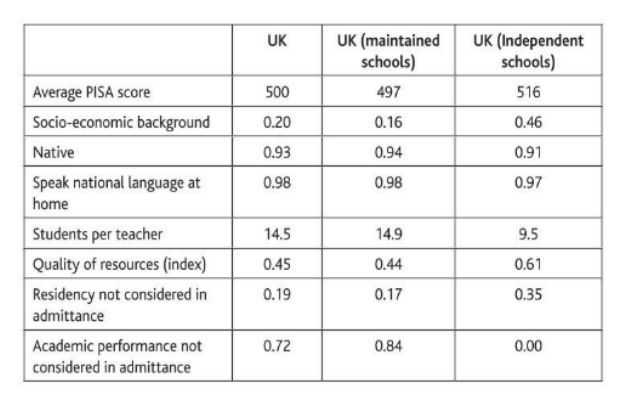
Table: State vs private school (Reay 2017: 45)
The quality of resources is far higher in private schools compared to that of state schools. Consequently, private schools are not only facilitating the development of an elite class but also becoming the primary instrument for enabled the ruling class to maintain a high standing position in all aspects of the society, including politics, laws, media, and even in the sports. In 2016, for example, 28% of participants who participated in Rio Olympics from the UK were from private schools, compared with 20% in the 2012 Olympics. In the 2016 Olympics, six ex-students from one private school in Somerset participated (Pells 2016). Our current Prime Minister is from a private school and his daughter is also going to private school, demonstrating Marx’s criticisms of education even in the present world, where the views are transferring from generation to generation.
Conclusion
Education is the process of acquiring knowledge and understanding, but Marx visualised it as a tool to exploit the lower class in a capitalist society. In some cases, Marx’s views are supported in modern-day England. Separate private schools and in some cases grammar schools reinforce a sense of social class in society. Children from wealthy families are attending private schools, where they learn, in a way, that they can do better than most of the poorer children going to state schools. Students from private schools have better access to resources and better teacher to student ratios. Moreover, mixing with middle-class students helps to re-enforce the upper-class culture allowing it to flourish at an even higher level. Ensuring the dominance of the upper-class in society. We can still see the low representation of students from working-class backgrounds in the top universities, where admission is so competitive for most of the working-class students. The white-collar jobs are also dominated by upper-class elites with some representation of the middle class. In this sector, the working class is mostly engaged in low paid blue-collar jobs, though they have some minor representation in white-collar professions. On the other hand, over the period of time, education creates a sense of reality in the society, and that has resulted in a separate attempt for some elite universities to recruit some students from working class backgrounds. However, the purpose of education is not only about the institution and the part played in delivering hidden agendas of capitalist society, it is also about expanding an individual’s knowledge and understanding within a changing environment. History suggests that Marx’s criticism of social class and its management of education still exist in modern-day England. However, any new idea or knowledge can be education. This allows us to think about the purpose and meaning of education differently.
References
- Aubrey, K. and Riley, A. (2016). Understanding & Using Educational Theories. London: Sage Publications Ltd.
- BBC News. 2013. UK 'Now Has Seven Social Classes'. [online] Available at: <https://www.bbc.co.uk/news/uk-22007058\> [Accessed 9 Dec 2020].
- Bhattacharya, S. (2006). Foundations Of Education. New Delhi: Atlantic Publishers and Distributers.
- Bowles, S. and Gintis, H. (1976). Schooling in Capitalist America. Chicago, Ill.: Haymarket Books.
- Brown, M. and Brown, M. (2020_. Is There A Marxist Perspective On Education?. [online] Culturematters.org.uk. Available at: <https://www.culturematters.org.uk/index.php/culture/education/item/2819-is-there-a-marxist-perspective-on-education\> [Accessed 8 Dec 2020].
- Dictionary.com. (2020). Definition Of Education | Dictionary.Com. [online] Available at: <https://www.dictionary.com/browse/education\> [Accessed 8 Nov 2020].
- Giroux, H. (1983). Theories of Reproduction and Resistance in the New Sociology of Education: A Critical Analysis. Harvard Educational Review, 53(3):257-293.
- Hill, D. (2018). Education and social class: a Marxist response. In Simmons, R. and Smyth, J. (eds.), Education and Working Class Youth. London: Palgrave MacMillan.
- Hill, D. (2008). Social class and education. In Matheson D (eds.), An Introduction to the Study of Education. London: Routledge.
- Kelly, AV (2001). The curriculum: Theory and practice. 6th edn. London: Sage Publications.
- Marxists.org. (2020). The German Ideology. Karl Marx 1845. [online] Available at: <https://www.marxists.org/archive/marx/works/1845/german-ideology/ch01b.htm#b3\> [Accessed 11 Dec 2020].
- Pells, R. (2016). Private school students have a better chance of being Olympic champions, claims Sir Steve Redgrave. The Independent, [online] Available at: <http://Private school students have a better chance of being Olympic champions, claims Sir Steve Redgrave> [Accessed 17 Dec 2020].
- Reardon, S. (2011). The widening academic achievement gap between the rich and the poor: New evidence and possible explanations. In G. J. Duncan and R. J. Murnane (Eds.), Whither opportunity? Rising inequality, schools, and children’s life chances New York: Russell Sage Foundation. pp. 91–116.
- Reay, D. (2017). Miseducation: Inequalities education and the working classes. Bristol: Policy Press.
- Steele, T. and Taylor, R. ( 2004). Marxism and Adult Education in Britain. Policy Futures in Education, 2(3-4):578-592.
- UK GOV. (2020). The Purpose Of Education. [online] Available at: <https://www.gov.uk/government/speeches/the-purpose-of-education\> [Accessed 8 Nov 2020].
- UN (2020).United Nations Millennium Development Goals. [online] Available at: <https://www.un.org/millenniumgoals/\> [Accessed 8 Dec 2020].
How to cite
Faqruzzaman, G. and Jahan, T. (2021) ‘Literature Review: Education and Social Class, A Focus on Marxist Ideology’, Journal of Contemporary Development & Management Studies, 9(1), pp. 88–93.
Converted from the printed issue (vol09-no1-2021.pdf, PDF pages 88–93). The PDF is the version of record.