Abstract
The establishment of dynastic presidents in Syria is a clear move to bring stability, modernisation and hoped-for prosperity to the country. How this is achieved throws up some interesting paradoxes. As a President, Hafez-al-Assad was a strong character, whose tactics were controlling and ruthless. This also describes the modus operandi later adopted by his son and successor, Bashar al-Assad. The West played no part in the planned future of the country under these regimes, as both al-Assads considered Russia to be the main supportive force. Syrian political direction under the al-Assads has experienced fragmentation of the country and embattled presidencies.
Keywords
Syrian identityal-AssadstabilityabusesBa'thismArabismcrisis
Introduction
The façade of stability in Syria was established by Hafez al-Assad. Before the 'Corrective Movement' that brought in Assad, Syria experienced prolonged instability which is evidenced by the multitude of military coups (SANA, 2017b; Jorum, 2014; Helfont, 2015; Lesch, 2005). The literature considers Assad's regime as a period of stability in Syria, based on his tight control of Syrian society from his retention of the presidency from 1971 until his death in 2000 (Khatib, 2011; Gelfand, 2013; Jorum, 2014; Zisser, 2006; Rifai, 2014). Further, Rifai (2014) understands the 2011 Syrian uprising to have "upset the equilibrium" within the Syrian identity. However, we propose another explanation: it is possible that an initial 'balance' merely existed due to the immense control exhibited by Assad, and the uprisings that spread across the MENA provided an opportunity that exposed the competing elements within the identity (Morrell & Papé, 2018). The roots of Ba'thism in Syria and Assad's role in implementing a single Syrian national identity, specifically are discussed by exploring four components generated throughout Assad's dominion that engendered an ostensible stability: 1) the violence of Assad's regime and political repression, 2) unifying elements in his discourse, 3) unification through securitisation, and 4) Assad's unique personality cult.
Following Hafez's death, his son, Bashar al-Assad assumed power. Since the Syrian identity crisis emerged, there have been allegations that Bashar al-Assad has committed numerous human rights abuses against his people; including a persistent use of chemical weapons, attacks on civilians, withholding humanitarian aid, using starvation as a tactic, the practice of torture, and the grave mistreatment and disappearances of detainees (Nebehay, 2017; France-Presse, 2017; Calamur, 2018; Human Rights Watch, 2018; Amnesty International, 2017). However, his presidency did not start out in this way. Bashar al-Assad's ascension to presidency was accompanied by feelings optimism by Syrians and external actors alike (Houry, 2010; Plett, 2000; Lesch, 2013). As his rule unfolded, it became apparent that he adopted his father's tactics towards political repression and violence, although Human Rights Watch (2001) highlighted his slight shift from Hafez's example. Indeed, Bashar's control over Syria has been explained by analysts as weaker than his father's (Statcher, 2011; Hinnebusch, 2002; BBC News, 2012a). This chapter argues that Bashar did not hold the same firm grip on Syria as his father, which exposed the Syrian identity crisis. This will be done firstly by examining how equipped Bashar was for succeeding his father in the first section, followed by an analysis of the 'Damascus Spring' and various reforms undertaken and there implications in the second section.
Some key dates in the formation and development of Syrian history are shown in Table 1. It is not known whether any of Bashar al-Assad's children, Hafez, Jr., Zein or Karim will accede to power in the future.
| Historical Timeline⁷ | |
|---|---|
| 1860 | Damascus Massacre of Christians by Damascene Muslims; failure of French Mission to protect Maronite Christians) |
| 1916 | Execution of nationalist martyrs in Damascus and Beirut; Sykes-Picot Agreement |
| 1920 | The beginning of the French Mandate |
| 1922 | Separation of Jabal al-Druze and the region behind Latakia into autonomous units |
| 1942 | Jabal al-Druze and region behind Latakia united with the rest of Syria |
| 1946 | End of the French Mandate; Syria gains full independence |
| 1947 | Ba'th Party is founded |
| 1949 | General Husni al-Zaim's military coup |
| 1949 | Sami al-Hinnawi's military coup |
| 1949 | Colonel Adib Shishakli's military coup |
| 1951 | Second military coup of Colonel Adib Shishakli |
| 1953 | Ba'th Party unites with the Arab Socialist Party |
| 1958 | Formation of United Arab Republic, the union between Syria and Egypt |
| 1961 | Military coup and subsequent independence from UAR |
| 1963 | Successful military coup by the Ba'th Party |
| 1970 | Hafez al-Assad acquires political power, known as the Corrective Movement |
| 1982 | The Hama Massacre |
| 1994 | Bassel al-Assad's death |
| 2000 | Hafez al-Assad dies, and Bashar al-Assad assumes presidency |
| 2011 | The 'Arab Spring' uprisings across the MENA; Large demonstrations in Daraa following the detention of children; The start of the Syrian civil war |
Table 1: Important dates in Syrian history
Hafez al-Assad's Politics
Research (Morrell, 2018) evidences that within the Syrian identity is a representation of an anti-Western and anti-colonisation sentiment, which has been translated into Syrian politics. This is evident in the rise of Ba'thism in Syria, originating as an intellectual stream in the 1940s and 1950s in reaction to the French Mandate. This intellectual current sought to build a Syrian state independent from colonial domination (Charlcraft, 2016; Hinnebusch, 1991; Borneman, 2007). The Ba'th Party developed a mass base after uniting with the Arab Socialist Party in 1953 (Charlcraft, 2016; Lawson, 2013), and since 1963, the BASP Ba'ath Arab Socialist Party (BASP) has maintained political power over Syria (BBC News, 2012b; Charlcraft, 2016; Jorum, 2014). Thus, the BASP constitution is central to the political identity of Syria.
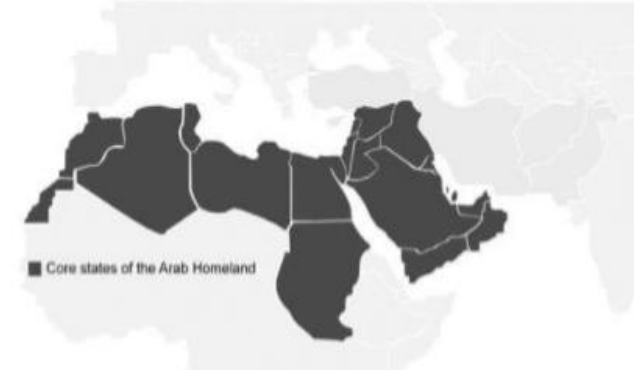
Figure 1: Common Arab delineation of the Arab Homeland (Culcasi, 2012: 1102)
Four of the first seven principles of the BASP constitution refer to the criminality of colonialism in addition to the indivisibility of the "Arab Homeland" that will be liberated by fighting foreign colonialism (The Ba'ath Arab Socialist Party, 2015). The Arab Homeland, which is defined in Article Seven of the constitution, is displayed in Figure 1, incorporating most of the MENA region, from Morocco in the West to the Gulf in the East. Two main points can be observed here: 1) the desire to revert to the natural Arab state, before foreign interference and division, and 2) the feeling of indignation by Syrians towards actions committed by the West to the point that they are perceived as criminal. To conclude, Ba'thism in Syria was developed in direct reaction to imperialism and sustained the regime's political power since 1963, becoming an imprinted component of Syria's national identity. This reactionary ideology that exhibits anti-colonial, anti-Western sentiments has deeply shaped the Syrian nation for half a century.
Enforcing a Sense of Stability
Hafez al-Assad sought to harness the conflicting and competing ethno-religious sub-national identities that remained following the French decampment and to create a single unified Syrian national identity; notably, Assad's political inclinations were born in reaction to French colonialism, having grown up in the Latakia area (Kerr, 2015; Hopwood, 2014). Much of Assad's rhetoric and policies created an ostensible unity and stability.
To begin with, stability was fostered through sometimes violent political repression; Assad suppressed all opposition, both external and internal, which enabled his maintenance of power. For instance, Assad suppressed internal party dissidence through cronyism and a general marginalisation of the BASP (Charlcraft, 2016), whilst external opposition suppression is exemplified most famously by the Hama massacre and the sequential suppression of the Muslim Brotherhood (Baczko, et al., 2017; Wiedl, 2006; Eijk, 2016). Human Rights Watch (2000) condemned Assad's control, highlighting the harsh punishments given to human rights activists, unexplained 'disappearances' and the harsh repression that reflected Assad's tenure. Further, Wedeen (1998) discusses the treatment of a Syrian Presidential Guard who, when asked to recount his dreams, did not follow previous soldiers' examples extolling the glorification of Assad to an appropriate degree and subsequently was beaten and discharged. Here we can see what Wedeen (1998: 506; 2015: 3) refers to as the "anxiety-inducing simulacrum" of Assad's regime. As evidenced from the suppression of the internal party and external opposition, in addition to the fear-generating punishments and treatment of those who resisted the regime's prescribed society, it can be argued that Assad's dominion was preserved through an authoritarian, repressive rule that exhibited immense control and violently suppressed dissidence.
A sense of stability and unity was fostered additionally through implementation of Assad's perception of the national identity, through a calculated rhetoric. For instance, Assad's utopian vision of a unified Syrian identity led him to ban discussions of Alawite-Sunni differences, which fostered an apparent unity. As one Alawite explained "we and the Sunnis are closer than in the past, because of civilisation, the media, and so on" (Pope, 2000; Goldsmith, 2015; Aggestam & Dunne, 2016). Further, in a speech made in 1999, Assad proclaims,
"...our people granted me their unanimous confidence which comes as a marvellous manifestation of our national unity and internal strength... Syria will continue seriously to work for attaining Arab solidarity... The homeland is in need of much work, much sweat and blood of each citizen. The homeland is a question of destiny, of the present and of the future. Let's work to safeguard the home irrespective of great sacrifices. I promise citizens to be always with them in shouldering the home's burdens." (Syria Times, 2012)
Many observations can be drawn from this extract. Firstly, Assad uses the example of his (forcibly) endured tenure to proclaim an example of the strong unity that Syria houses among its people. Secondly, Assad expresses his commitment to a unification that transcends the nation, suggesting that Syrian unity is no longer the issue, but accomplishing the unified Arab 'homeland'. Finally, by referencing the 'homeland', he enkindles an abiding bond drawing on Syrian emotions, a sense of inherent belonging to the Arab nation from which Syrians had been severed. These rhetorical components are not unique to this speech⁸. Therefore, it can be concluded here that Assad created a superficial unity through reducing discursive freedoms concerning ethno-religious differences in addition to the wide-spread rhetoric that was judiciously expressed.
In addition to his commitment to Arabism, Assad proclaimed his opposition to both Israel and American imperialism, which, according to Farouk-Alli (2015), provided another means of creating internal unity. Similarly, in a speech in 1971, Assad spoke of the unity among those that resist colonialism (presidentassad.net, n.d.e). This demonstrates the way in which a construction of an existential threat can be used as a unifying factor for a society. Consistent with how Huysmans (2006) and O'Nions (2016) understand insecurity, the proclamation of visible external adversaries constructs an existential threat, creating a sense of societal unity, since the Syrian society is defined, constructed and rallied against the Israeli or American 'Other'. Interestingly, a threat can be de-securitised, which indicates the amenability of such unity and, perhaps, suggests the temporary nature of a unity that is forged out of shared feelings of insecurity (Buzan & Wæver, 2003; Huysmans, 2006). Thus, part of the nation's unity is derived from that which Assad securitised, a unity that seems temporary and malleable.
Assad maintained an interesting cult of personality. Because it was operational, yet, unconvincing, it is worth discussing based on its instrumental value to the Syrian national identity and unity. The dominion Assad held was characterised by an invasive cult of personality in which he personified the regime. This was recognised by Assad himself, who allegedly said to his brother, "You want to overthrow the regime? ...Here I am. I am the regime." (Seale & McConville, 1990: 435; Statcher, 2011). Moreover, according to Statcher (2011), Syrian stability was understood by many through his exhibited personality. Yet, whilst Assad's personality cult was very much real, it did not operate generically, as Wedeen's (2015; 1998) impressive research explains. Indeed, Assad's personality cult did not manufacture nationwide belief, but forced citizens to operate as if it did, which gave 'Syrian' a new meaning; under Assad it became the ability "to operate...within the universe of the official rhetoric" (Wedeen, 1998: 504-505; 2015). It seems that Assad's personality cult embodied the façade of stability. Assad manufactured the 'equilibrium' that Rifai (2014) refers to through the creation of a national structure formed through calculated rhetoric, immense violent control and political repression, within which Syrians were forced to operate, and incorporated an enforced balance between Arabism, Syrianism and Islamism. Subsequently, this inhibited intercommunal ethno-religious conflict, since discussions of ethno-religious difference were prohibited. This was a 'façade'. Although official rhetoric emphasised commitment to unity, the enforcement of Assad's identity equilibrium only succeeded in silencing temporarily competing interests within the Syrian identity.
Concluding, when exploring the rise of Ba'thism and the apparent unity fostered within Syrian society, this article suggests that what has been associated with stability during Assad's tenure, was a façade in which divisions within the national identity were suppressed and forced to lie dormant. In the following section, the authors explore the influence of the present ruler Bashar al-Assad on the development of Syria.
Bashar al-Assad
Weakened Control: Starting on the Back Foot
Notably, Bashar al-Assad was not bred for politics. It was his brother who was destined to succeed his father. However, following his brother Bassel's death in 1994, Bashar was summoned to assume his brother's role (Fisk, 1994; Schmidt, 1994; Moubayed, 2006; Aikman, 2009).
According to Lesch (2005: 4):
The combination (of) computer nerd, ophthalmologist, devoted family man, westernized pop-culturist, outgoing and caring friend, humble and reluctant leader, avid photographer, health and fitness advocate, and lurking reformer had all of a sudden become a Middle Eastern dictator. He entered upon a region, and soon a world, in turmoil.
The significance of this lies in its implications for the suitability of Bashar al-Assad to rule. His brother's untimely death meant that Bashar was to succeed. However, unlike Bassel, he had not been bred for political rule and so, perhaps he was not informed comprehensively of his father's strategies and plans. His lack of suitability and preparation for this role left him in an undesirable position, which was intensified somewhat by the contextual state in which he was forced to rule. Indeed, Zisser (2000: 10) writes, Hafez 'left his son in a country in total decline' regarding socio-economics, globalisation, and issues in Lebanon and Israel, let alone 9/11 and the 'War on Terror' (Webel & Tomass, 2017; Katz, n.d.). It can be deduced, therefore, that Bashar entered his dominion in a difficult position given his lack of 'training' and the challenging issues he was forced to confront.
Appearing Weak: The 'Damascus Spring'
The slight shift away from his late father refers to the 'Damascus Spring': a brief period following the death of Hafez al-Assad in 2000, characterised by political opposition and activism through informal forums and tentative liberalisation (Carnegie Middle East Center, 2012c). During this 'Spring', Bashar al Assad did not inhibit the emerging civil society organisations like his father had done, but made movements towards reform. Among other things, he diversified authoritarian control somewhat by permitting the parties of the governing National Progressive Front to set up regional offices and produce newspapers, and, at the same time, the new regime released hundreds of political prisoners (Lesch, 2005; Wieland, 2012; Ghadry, 2005; Leverett, 2005; Carnegie Middle East Center, 2012c). Additionally, Bashar ordered state media to avoid using terms like "immortal president" to refer to his late father, to refrain from glorifying or exaggerating strategies used in the state-run news campaigns and ordered posters and signs with his own image to be removed gradually (Plett, 2000; Leverett, 2005: 168; Phillips, 2013).
Firstly, the absence of images of the leader from the streets of Syria may have made Bashar appear more distant and less omnipotent, omnipresent and omniscient than his father, for the posters had served as visual reminder of Hafez's presence, power and personality cult. It is possible that this led to Syrians feeling as if they need not pretend 'as if' anymore. Further, considering Bashar seemed unequipped for the leadership, it perhaps fostered a sense within society of his lack of firm control over the nation in comparison to the familiarity of his father's dominion. Secondly, perhaps the small, tentative reforms early in the regime unveiled a path to the Syrian society that led to the eventual exposure of the cracks in the identity. As Ghadry (2005) explains, new fora that were created to discuss reformation and civil society during the Damascus Spring acted as a springboard for a new generation of leadership that, in turn, manufactured new currents of reformist thought.
Although Zisser (2007: 50) through a surveillance of Syrian newspapers, concluded that there was no difference in the treatment of Bashar al-Assad in comparison to his father, Phillips (2013: 57) notes the normalised reluctance of Syrian media to criticise a president and instead, highlights a shift in depictions of Hafez, who was referred to by "grand titles" in comparison to Bashar, who was simply "al-rais" (the president). Further, Phillips (2013) maintains that Hafez was more feared and militaristic than Bashar who initially was more popular. Perhaps these grand depictions of Hafez in comparison to Bashar reflect the control Hafez possessed and the fear he created within the society in comparison to his son's.
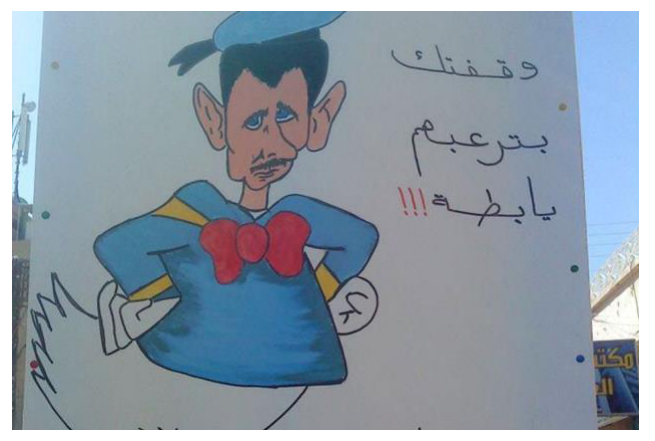
Figure 2: A cartoon depicting Bashar al-Assad as a duck is displayed at a rally in the northern city of Al-Hasakah (ABC News, 2012)
Further, Bashar was ridiculed by his opponents. After an email was leaked between him and his wife in which the First Lady of Syria called him her "batta" (duck), opposition activists likened Bashad to the comical cartoon character, Donald Duck (Al Arabiya, 2012; ABC News, 2012; Rundle, 2012). In addition, he was represented as a giraffe (aberoia11, 2011; Medi Belortaja, 2009). Accordingly, it seems that Bashar al Assad was not the feared and respected 'lion' that his father had been (Wright, 2017; MacAskill, 2000; Lesch, 2005). He seemed to be much less respected than his father, and his dominion was not as far-reaching. Therefore, the control that Bashar possessed could not prevent Syria from falling into civil war, nor did it preserve any respect for his authority.
The Syrian Uprising
It could be argued that Bashar al-Assad's slight weakening of control served as a prelude. When the first uprisings appeared in Tunisia and Egypt (Cherif, 2017), Syrians felt able to take advantage of the opportunity that had presented itself. Furthermore, as Farouk-Alli (2015) highlights, the internal cohesion that was constructed by his father was not enough to shield the Syrian state from the looming threat of the uprising. The failure of internal cohesion constructed by the Assad regime, when contextually analysed, can explain how the uprising in Syria unfolded.
Before 2011, Syria comprised one of the largest 'youth bulges'⁹ in the world, a high youth unemployment rate and high levels of food insecurity, due the regime's failure to prepare for and respond to a lengthy, devastating drought from 2006 to 2010 (Amos, 2010; UNDP, 2013; Jones, 2017; Sample, 2015). The Government's failure to respond, generated massive discontent within a disproportionally young society and contributed substantially to the strength of the uprisings that Assad's façade of unity was unable to prevent from unfolding in Syria.
The social movement that spread through the MENA was an opportunity that breathed life into the competing components within the Syrian identity that are prevalent within the current conflict. The Syrian uprising unveiled the identity crisis that had existed in Syria, which had been previously shrouded by Hafez's repressive control. Indeed, Kaplan (1993) predicted that there would be a "reckoning" concerning identity when Hafez's control weakened. This is similarly alluded to by Seale in his interview with Assad concerning deeper societal concerns in a post-Assad Syria (al-Assad & Seale, 1993).
It is possible then, that identity instabilities, engendered initially by the implementation of French divisive strategic policies, brewed unobserved and suppressed beneath a constructed camouflage of stability built by Hafez. The fallacy, however, failed to endure the crashing waves of the Arab uprisings.
In conclusion it is evidenced that Bashar al-Assad's weakened control of society allowed cracks in the identity façade to resurface and, ultimately, engendered a violent identity conflict in the form of a civil war. Indeed, the façade that Hafez attempted to fortify was not strong enough to protect his dynasty from dissolution. The authors maintain that the current identity crisis is one that has been suppressed for decades. A forthcoming article addresses the rising identity components that contributed to the crisis.
References
- ABC News, (2012). Cartoon Depicts Bashar al-Assad as a Duck. [Online] Available at: http://www.abc.net.au/news/2012-03-30/cartoon-depicts-bashar-al-assad-as-a-duck/3923096 [Accessed 13 February 2018].
- Aggestam, K. & Dunne, T.,(2016). The failure of diplomacy and protection in Syria. In: S. Smith, A. Hadfield & T. Dunne, eds. Foreign Policy: Theories, Actors, Cases. Oxford: Oxford University Press, pp. 476-494.
- Aikman, D., 2009. The Mirage of Peace: Understanding the Never-Ending Conflict in the Middle East. Grand Rapids: Baker Books.
- Al Arabiya, (2012). From Lion to 'Duck': Assad's nickname goes viral. [Online] Available at: https://english.alarabiya.net/articles/2012/03/28/203829.html [Accessed 13 February 2018].
- Amnesty International, (2017). Syria: Human Slaughterhouse: Mass Hangings and Extermination at Saydnaya Prison, Syria. [Online] Available at: https://www.amnesty.org/en/documents/mde24/5415/2017/en/ [Accessed 16 February 2018].
- Amos, D., (2010). Syrian Youth Unprepared for Market-Driven Economy. National Public Radio, [Online] Available at: https://www.npr.org/templates/story/story.php?storyId=130222200 [Accessed 16 January 2018].
- Baczko, A., Dorronsoro, G. & Quesnay, A., (2017). Cvil War in Syria: Mobilization and Competing Social Orders. Cambridge: Cambridge University Press.
- Baofu, P., (2010.) The Future of Post-Human War and Peace: A Preface to a New Theory of Aggression and Pacificity. Newcastle upon Tyne: Cambridge Scholars Publishing.
- BBC News, (2012a). Bashar al-Assad's inner circle. [Online] Available at: http://www.bbc.co.uk/news/world-middle-east-13216195 [Accessed 15 January 2018].
- BBC News, (2012b). Profile: Syria's ruling Ba'ath Party. [Online] Available at: http://www.bbc.co.uk/news/world-middle-east-18582755 [Accessed 10 January 2018].
- Borneman, J., (2007). Syrian Episodes: Sons, Fathers, and an Anthropologist in Aleppo. New Jersey: Princeton University Press.
- Burrows, M., (1986). 'Mission Civilisatrice': French Cultural Policy in the Middle East, 1860-1914. The Historical Journal, 29(1), pp. 109-135.
- Buzan, B. & Wæver, O., (2003). Regions and Powers: The Structure of International Security. Cambridge: Cambridge University Press.
- Calamur, K., 2018. Assad Is Still Using Chemical Weapons in Syria. The Atlantic,[Online] Available at: https://www.theatlantic.com/international/archive/2018/02/syria-chemical-weapons/552428/ [Accessed 16 February 2018].
- Carnegie Middle East Center, (2012c). The Damascus Spring. [Online] Available at: http://carnegie-mec.org/diwan/48516?lang=en[Accessed 12 February 2018].
- Charlcraft, J., (2016). Popular Politics in the Making of the Modern Middle East. Cambridge: Cambridge University Press.
- Cherif, Y., (2017). Will the 2010s be the 'wasted decade' of Arab hopes?. Al Jazeera,[Online] Available at: http://www.aljazeera.com/indepth/opinion/2010s-useless-decade-arab-hopes-171218072522055.html[Accessed 15 January 2018].
- Commins, D. & Lesch, D. W., (2014). Historical Dictionary of Syria. 3rd ed. Lanham: Scarecrow Press.
- DeRouen, K. & Heo, U., (2005). Defense and Security: A Compendium of National Armed Forces and Security Policies. Santa Barbara: ABC-CLIO.
- Eijk, E. V., (2016.) Family Law in Syria: Patriarchy, Pluralism and Personal Status Laws. London: I.B. Tauris.
- Farouk-Alli, A., (2015). The Genesis of Syria's Alawi Community. In: M. Kerr & C. Larkin, eds. The Alawis of Syria: War, Faith and Politics in the Levant. Oxford: Oxford University Press, pp. 27-48.
- Fildis, A. T., (2011.) The Troubles in Syria: Spawned by French Divide and Rule. Middle East Policy, 18(4), p. 129–139.
- Fisk, R., 1994. Syria mourns death of a 'golden son': Basil Assad's fatal car crash throws open the question of who will succeed the president, writes Robert Fisk in Beirut. The Independent,[Online] Available at: http://www.independent.co.uk/news/world/syria-mourns-death-of-a-golden-son-basil-assads-fatal-car-crash-throws-open-the-question-of-who-will-1408555.html[Accessed 16 February 2018].
- France Diplomatie, (2015). Mandat Syrie-Liban: 1920-1946. [Online] Available at: https://www.diplomatie.gouv.fr/IMG/pdf/III\_-\_Protmand\_modifie\_mandat.pdf [Accessed 15 January 2018].
- France-Presse, A., (2017). Bashar al-Assad's forces responsible for deadly Syria sarin gas attack, UN finds. The Telegraph,[Online] Available at: http://www.telegraph.co.uk/news/2017/10/26/bashar-al-assads-forces-responsible-deadly-syria-sarin-gas-attack/ [Accessed 16 February 2018].
- Gelfand, D. E., (2013). Syria. Minneapolis: ABDO Publishing.
- Ghadry, F. N., (2005). Syrian Reform: What Lies Beneath. The Middle East Quarterly, 12(1), pp. 61-70.
- Goldsmith, L. T., (2015). Cycle of Fear: Syrias Alawites in war and Peace. London: C. Hurst & Co..
- Helfont, S., (2015). Post-Colonial States and the Struggle for Identity in the Middle East since World War Two. Foreign Policy Research Institute,[Online] Available at: https://www.fpri.org/article/2015/10/post-colonial-states-and-the-struggle-for-identity-in-the-middle-east-since-world-war-two/ [Accessed 2 January 2018].
- Hinnebusch, R. A., (1991). Class and State in Ba'thist Syria. In: R. T. Antoun & D. Quataert, eds. Syria: Society, Culture and Polity. Albany: State University of New York Press, pp. 29-48.
- Hinnebusch, R.A., (2002). Syria: Revolution from Above. London: Routledge.
- Hopwood, D., (2014). Syria 1945-1986: Politics and Society. London: Routledge.
- Houry, N., (2010). Syria's decade of repression. The Guardian,[Online] Available at: https://www.theguardian.com/commentisfree/2010/jul/16/syria-decade-repression-bashar-al-assad [Accessed 11 January 2018].
- Human Rights Watch, (2000). Syria: Human Rights Developments. [Online] Available at: http://pantheon.hrw.org/legacy/wr2k/Mena-09.htm[Accessed 11 January 2018].
- Human Rights Watch, 2018. World Report 2018: Syria: Events of 2017. [Online] Available at: https://www.hrw.org/world-report/2018/country-chapters/syria[Accessed 16 February 2018].
- Huysmans, J., (2006). The Politics of Insecurity: Fear, Migration and Asylum in the EU. Oxon: Routledge.
- Jones, A., (2017). Food security: how drought and rising prices led to conflict in Syria. The Conversation, [Online] Available at: http://theconversation.com/food-security-how-drought-and-rising-prices-led-to-conflict-in-syria-71539[Accessed 16 January 2018].
- Jorum, E. L., (2014). Beyond Syria's Borders: A History of Territorial Disputes in the Middle East. London: I.B. Tauris.
- Kaplan, R. D., (1993). Syria: Identity Crisis. The Atlantic,[Online] Available at: https://www.theatlantic.com/magazine/archive/1993/02/syria-identity-crisis/303860/[Accessed 4 January 2018].
- Katz, M. N., (n.d). The Geopolitical Context of the "War on Terror". Middle East Policy Council,[Online] Available at: http://www.mepc.org/commentary/geopolitical-context-war-terror [Accessed 15 February 2018].
- Kaufmann, E. P. & Toft, M. D., (2012). Introduction. In: J. A. Goldstone, E. P. Kaufmann & M. D. Toft, eds. Political Demography: How Population Changes Are Reshaping International Security and National Politics. Boulder: Paradigm Publishers, pp. 3-9.
- Kerr, M., (2015). Introduction: For 'God, Syria, Bashar and Nothing Else'?. In: M. Kerr & C. Larkin, eds. The Alawis of Syria: War, Faith and Politics in the Levant. Oxford: Oxford University Press, pp. 1-26.
- Khatib, L., (2011). Islamic Revivalism in Syria: The rise and fall of Ba'thist secularism. Oxon: Routlege.
- Khoury, P. S., (1987). Syria and the French Mandate: The Politics of Arab Nationalism, 1920-1945. New Jersey: Princeton Legacy Library.
- Lawson, F. H., (2013). Global Security Watch: Syria. Santa Barbara: Praeger.
- Lefèvre, R., (2015). Islamism within a civil war: The Syrian Muslim Brotherhood's struggle for survival. Brookings, [Online] Available at: https://www.brookings.edu/wp-content/uploads/2016/07/Syria\_Lefevre-FINALE.pdf[Accessed 22 January 2018].
- Lesch, D. W., (2005). The New Lion of Damascus: Bashar al-Asad and Modern Syria. New Haven: Yale University Press.
- Lesch, D. W., (2013). Syria: The Fall of the House of Assad. New Haven: Yale University Press.
- Leverett, F., (2005). Inheriting Syria: Bashar's Trial by Fire. Wahington, D.C.: Brookings Institution Press.
- MacAskill, E., (2000). Last Roar for the Lion of Damascus. The Guardian,[Online] Available at: https://www.theguardian.com/world/2000/jun/14/israel1 [Accessed 15 February 2018].
- McHugo, J., (2014). Syria: From the Great War to Civil War. London: Saqi Books.
- Medi Belortaja, (2009). Bashar al Assad. Toon Pool, [Online] Available at: https://www.toonpool.com/cartoons/bashar al assad\_66105[Accessed 15 February 2018].
- Morrell, I. (2018). 'The Syrian Identity: An exploration of the legacy of colonialism', unpublished Dissertation submitted for BA award at University of Birmingham
- Morrell, I. and Papé, N.R. (2018). The Syrian Identity (1): An exploration of the legacy of colonialism illuminating the diaspora of a nation, Journal of Contemporary Development & Management Studies, 6:1, pp. 66-78.
- Moubayed, S., (2006). Steel & Silk: Men & women who shaped Syria 1900-2000. Seattle: Cune Press.
- Nebehay, S., (2017). Syrian government forces used chemical weapons more than two dozen times - U.N.. Reuters, [Online]. Available at: https://uk.reuters.com/article/uk-mideast-crisis-syria-warcrimes/syrian-government-forces-used-chemical-weapons-more-than-two-dozen-times-u-n-idUKKCN1BH19Z [Accessed 16 February 2018].
- O'Nions, H., (2016). Asylum - A Right Denied: A Critical Analysis of European Asylum Policy. Oxon: Routledge.
- Phillips, C., (2013). Everyday Arab Identity: The Daily Reproductoin of the Arab World. Oxon: Routledge.
- Plett, B., (2000). Syria's changing face. BBC News,[Online] Available at: http://news.bbc.co.uk/1/hi/programmes/from\_our\_own\_correspondent/857527.stm [Accessed 15 January 2018].
- Pope, H., (2000). Syria's political changes threaten Alawites' power. Likoed Nederland,[Online] Available at: https://likud.nl/2000/06/syrias-political-changes-threaten-alawites-power/[Accessed 15 January 2018].
- presidentassad.net, n.d. e. (1971). Interviews. [Online] Available at: http://www.presidentassad.net/index.php?option=com\_content&view=category&id=170&Itemid=475 [Accessed 7 February 2018].
- Rifai, O., (2014). The shifting balance of identity politics after the Syrian uprising. Open Democracy,[Online] Available at: https://www.opendemocracy.net/north-africa-west-asia/ola-rifai/shifting-balance-of-identity-politics-after-syrian-uprising[Accessed 4 January 2018].
- Rundle, M., (2012). Syrian Uprising: Protesters Have Fun With Bashar 'The Duck' Assad's New Nickname. Huffington Post, [Online] Available at: http://www.huffingtonpost.co.uk/2012/03/30/assad-duck-satire-syria-uprising-protesters\_n\_1390590.html [Accessed 13 February 2018].
- Sample, I., (2015). Global warming contributed to Syria's 2011 uprising, scientists claim. The Guardian, [Online] Available at: https://www.theguardian.com/world/2015/mar/02/global-warming-worsened-syria-drought-study [Accessed 16 January 2018].
- SANA, (2017b). Workforce challenges addressed on Corrective Movement anniversary. [Online] Available at: https://sana.sy/en/?p=118224 [Accessed 12 January 2018].
- Schmidt, W. E., 1994. Assad's Son Killed in an Auto Crash. The New York Times,[Online] Available at: http://www.nytimes.com/1994/01/22/world/assad-s-son-killed-in-an-auto-crash.html [Accessed 16 February 2018]
- Seale, P. & McConville, M., (1990). Asad: The Struggle for the Middle East. Berkeley: University of California Press.
- Statcher, J., (2011). Reinterpreting Authoritarian Power: Syria's Hereditary Succession. Middle East Journal, 65(2), pp. 197-212.
- Sukarieh, M. & Tannock, S., (2015). Youth Rising? The Politics of Youth in the Global Economy. New York: Routledge.
- Syria Times, (2012). President Hafez al-Assad CV. [Online] Available at: http://www.syriatimes.sy/index.php/useful-information/telephone-numbers/114-other/151-president-hafez-al-assad-cv [Accessed 6 February 2018].
- The Ba'ath Arab Socialist Party, (2015). The Constitution of the Ba'ath Arab Socialist Party. [Online] Available at: http://www.Ba'athparty.org/index.php?option=com_content&view=category&id=307&Itemid=327&lang=en&limitstart=0 [Accessed 1 February 2018].
- Tomass, M., (2017.) The Ideological Origins of ISIS: Fighting Terror with Common Sense. In: C. Webel & M. Tomass, eds. Assessing the War on Terror: Western and Middle Eastern Perspectives. Oxon: Routledge, pp. 108-136.
- Ulrichsen, K. C., (2014). The First World War in the Middle East. London: C. Hurst & Co..
- UNDP, (2013). A clash of generations: How high percentages of young people can fuel conflicts. [Online] Available at: http://www.undp.org/content/undp/en/home/ourperspective/ourperspectivearticles/2013/12/20/a-clash-of-generations-how-high-percentages-of-young-people-can-fuel-conflicts-henrik-urdal.html [Accessed 16 January 2018].
- Webel, C. & Tomass, M., (2017). Assessing the War on Terror: Western and Middle Eastern Perspectives. Oxon: Routledge.
- Wedeen, L., (1998). Acting "As If": Symbolic Politics and Social Control in Syria. Comparative Studies in Society and History, 40(3), pp. 503-523.
- Wiedl, K. N., (2006). The Hama Massacre - Reasons, Supporters of the Rebellion, Consequences. Norderstedt: GRIN Verlag.
- Wieland, C., (2012). Syria, a Decade of Lost Chances. [Online] Available at: https://www.opendemocracy.net/carsten-wieland/syria-decade-of-lost-chances [Accessed 12 February 2018].
- Wright, R., (2017). The Assad Family: Nemesis of Nine U.S. Presidents. The New Yorker,[Online] Available at: https://www.newyorker.com/news/news-desk/the-assad-family-nemesis-of-nine-u-s-presidents [Accessed 15 February 2018].
- Zisser, E., (2000). Will Bashshar al-Asad Rule?. Middle East Quarterly, 7(3), pp. 3-12.
- Zisser, E., (2006). Who's Afraid of Syrian Nationalism? National and State Identity in Syria. Middle Eastern Studies, 42(2), pp. 179-198.
- Zisser, E., (2007). Commanding Syria: Bashar al-Asad and the First Years in Power. London: I.B. Tauris & Co. Ltd.
- Ziter, E., (2015). Political Performance in Syria: From the Six-Day War to the Syrian Uprising. Basingstoke: Palgrave Macmillan.
Notes
5 Main author. Correspondence to: isabel.morrell@hotmail.co.uk
6 Principal, London Churchill College
7 Based on the combined works of (Burrows, 1986; France Diplomatie, 2015; Fildis, 2011; Khoury, 1987; Kaplan, 1993; McHugo, 2014; Ziter, 2015; DeRouen & Heo, 2005; Ulrichsen, 2014; Commins & Lesch, 2014; Lefèvre, 2015; Charlcraft, 2016; Lawson, 2013).
8 For examples see: (presidentassad.net,n.d.e).
9 A 'youth bulge' is the large proportion of youth within the population (UNDP, 2013). Youth bulge theory argues that the combination of a disproportionally large youth population without stable employment contributes to political uprisings, activism and violence, based on the idea that the youth is a socially and politically motivated section of society (Kaufmann & Toft, 2012; Baofu, 2010; Sukarieh & Tannock, 2015).
How to cite
Morrell, I. and Papé, N. (2019) ‘The Syrian Identity (2): The Assad hegemony, a commentary on dynastic occupation and exploitation’, Journal of Contemporary Development & Management Studies, 7(1), pp. 26–37.
Converted from the printed issue (vol07-no1-2019.pdf, PDF pages 28–39). The PDF is the version of record. Text was recovered by OCR from an outlined-text PDF; check against the PDF before citing.